The Spanish translation of Hans-Hermann Hoppe, “De-Socialization in a United Germany,” Rev. Austrian Econ. 5, no. 2 (1991): 77–104 is below. [continue reading…]
Translation of Hoppe, Mises Institute: Quo Vadis? (Note: Due to Twitter currently blocking links from HansHoppe.com, it is mirrored at Mises Institute: Quo Vadis?)
Mises Institute: ¿Quo Vadis?
Hans-Hermann Hoppe
25 de marzo de 2026
Traducido al español por Martín Cabrera
Mi estrecha y personal relación con el Mises Institute se remonta a más de 40 años, concretamente, a 1985, apenas tres años después de la fundación del Instituto. A lo largo de los años he impartido decenas y decenas de conferencias. He recibido su Schlarbaum Prize y la Rothbard Medal. Durante una década fui editor de su Journal of Libertarian Studies. Soy el único Distinguished Senior Fellow de larga data del MI. Hace apenas dos años, en 2024, fui ponente destacado en la Human Action Conference del Instituto, y en esa ocasión se celebró mi 75º cumpleaños. Ese mismo año envié esta nota de felicitación a Lew Rockwell con motivo de los festejos organizados en honor a su propio 80º cumpleaños: [continue reading…]
I have today published Mises Institute: Quo Vadis? (Note: Due to Twitter currently blocking links from HansHoppe.com, it is mirrored at Mises Institute: Quo Vadis?)
Mises Institute: Quo Vadis?
Hans-Hermann Hoppe
March 25, 2026My close, personal association with the Mises Institute goes back more than 40 years, to 1985, only three years after the Institute’s founding. In the course of the years I have given dozens upon dozens of lectures. I have been awarded its Schlarbaum Prize and the Rothbard Medal. For a decade, I served as editor of its Journal of Libertarian Studies. I am the MI’s only long standing Distinguished Senior Fellow. Only two years ago, in 2024, I was a featured speaker at the Institute’s Human Action Conference, and my 75th birthday was celebrated at the occasion. In the same year I sent this congratulatory note to Lew Rockwell at the occasion of the festivities organized in honor of his own 80th birthday:
Dear Lew, to your 80th birthday I send you my best wishes and want to say thanks for by now almost 40 years of friendship and intellectual camaraderie.
I know you are too humble to say this, but I can certainly do it: You rank among the most brilliant commentators and analysts of the present age and you are the world’s greatest living promoter of sound economics in the tradition of Ludwig von Mises and Murray N. Rothbard and, more generally, of liberty, peace, common sense, and reason.
Your legacy is assured: You are already a legend.
Yours truly,
Hans
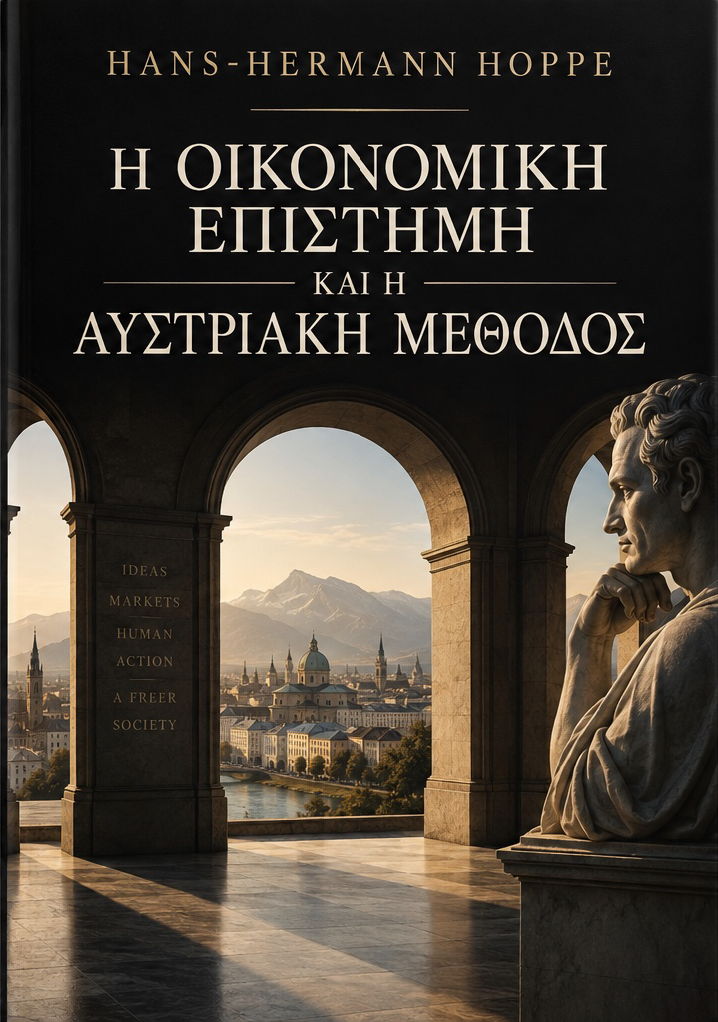
Professor Hoppe’s Economic Science and the Austrian Method (1995) has been translated into Greek as Η Οικονομική Επιστήμη και η Αυστριακή Μέθοδος (pdf; docx). Text below.
According to the translator, the aptly soi-disant Praxeologos,
Introducing this important work to a Greek audience that is largely unfamiliar with economics (and that includes Professors of Economics) would be of real value.
Please note that the translation includes the recommended bibliography in its original English form, but the footnotes are still missing.
From The Property and Freedom Blog:
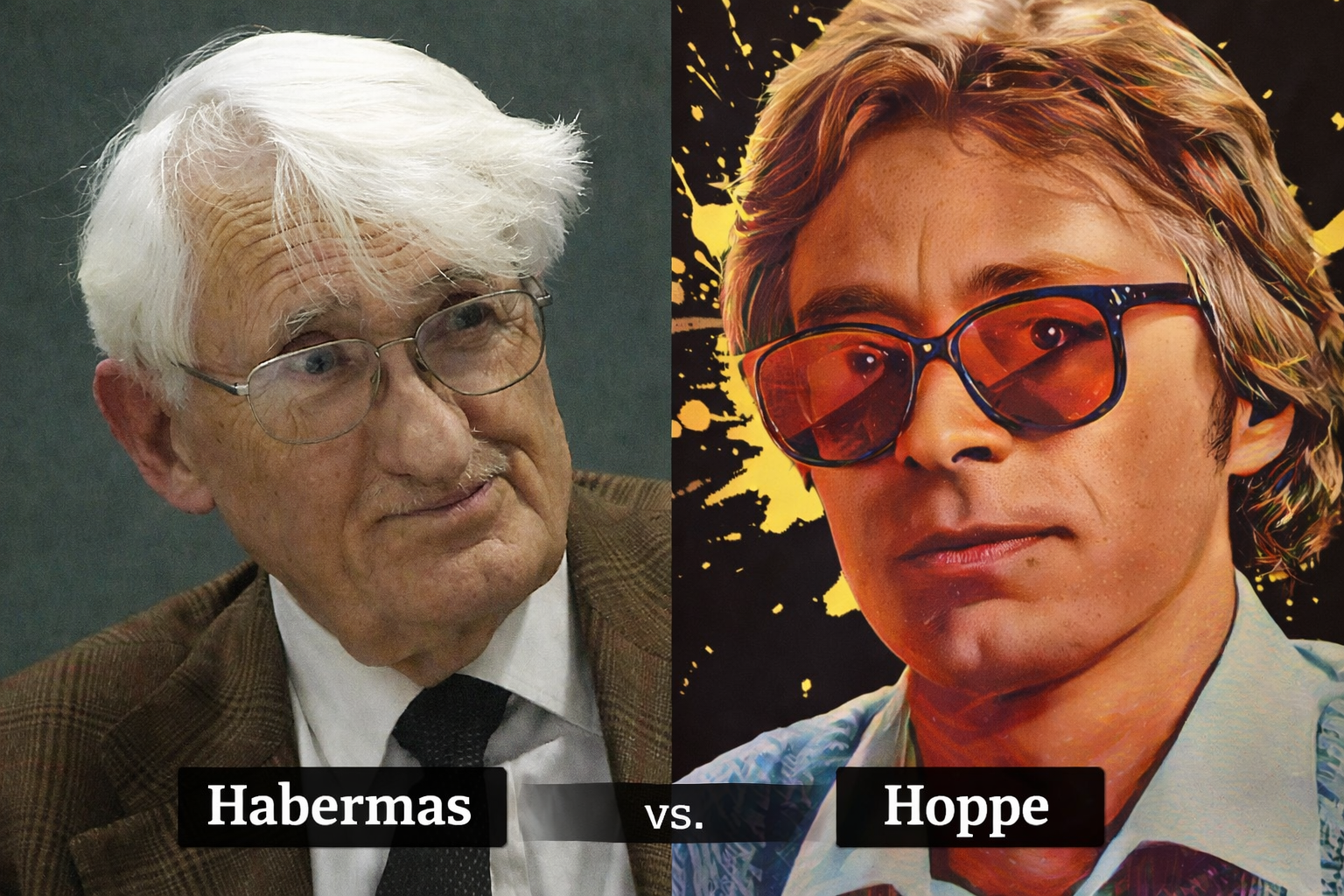
Neo-Marxist German philosopher Jürgen Habermas has died; see Jürgen Habermas, influential German philosopher, dies at 96Jürgen Habermas, influential German philosopher, dies at 96 (AP, March 14, 2026).
As admirers of Hans-Hermann Hoppe know, Habermas was one of Hoppe’s teachers and the principal advisor for his doctoral dissertation in Philosophy on David Hume and Immanuel Kant at Goethe-Universität, Frankfurt am Main from 1968–1974, Handeln und Erkennen [Action and Cognition] (Bern 1976) ). (At the time of time of his PhD dissertation, Hoppe was 24. He regards his “habilitation” thesis, written by the time he has reached intellectual maturity, and of course later work, as far more important than the PhD dissertation.) 1 Hoppe soon abandoned the leftism of Habermas and the Frankfurt School and adopted Misesian Austrian economics and Rothbardian anarchist libertarianism. As Grok and ChatGPT recognize, Hoppe is Habermas’s most famous but politically distant student (other prominent students of Habermas including more aligned figures like Axel Honneth, Rainer Forst, Claus Offe, and Hans Joas).
One thing Habermas became known for was his “discourse ethics”; 2 Hoppe later relied to some degree on aspects of this theory, and to a greater degree on the more coherent and fleshed out views of fellow leftist German philosopher Karl-Otto Apel, 3 in developing his own “argumentation ethics” radical defense of libertarian rights. 4 Some Hoppe critics have overstated impact of Habermas’s ideas on Hoppe’s views; for example, back in 2019, Hoppe-basher Phil Magness made a confused attempt to try to link Hoppe’s views on immigration to his Habermas, even though analysis of democracy and immigration and related views has nothing whatsoever to do with Habermas. 5 Even Hoppe’s rights theory has only a slight connection to Habermas; Hoppe was actually not even aware of Habermas’s discourse ethics when studying under him.
- For his “Habilitation” thesis, in Sociology and Economics, from Goethe-Universität, Frankfurt am Main, in 1981, see Hans-Hermann Hoppe, Kritik der kausalwissenschaftlichen Sozialforschung: Untersuchungen zur Grundlegung von Soziologie und Ökonomie [Critique of Causal Scientific Social Research: Studies on the Foundation of Sociology and Economics] (Opladen: Westdeutscher Verlag, 1983); Kinsella, Hoppe’s Habilitation Thesis: Critique of Causal Scientific Social Research. [↩]
- See Kinsella, Revisiting Argumentation Ethics; Discourse Ethics entry in Wikipedia (which yours truly started, and which has more on Hoppe and Habermas). [↩]
- Kinsella, Hoppe’s Argumentation Ethics and Its Critics. [↩]
- Hoppe, My Discovery of Human Action and of Mises as a Philosopher; PFP163 | Hans Hermann Hoppe, “On The Ethics of Argumentation” (PFS 2016), and other references in Kinsella, “Argumentation Ethics and Liberty: A Concise Guide” (2011) and Supplemental Resources. [↩]
- See Magness on Hoppe; the Kochtopus and the Mises Caucus; see also Prychitko on Habermas and Austrianism: Where’s Hoppe?; Hoppe: Habermas’s Anarcho-Conservative Student. [↩]
Recently translated into German, by Andreas Tank:
Hans-Hermann Hoppe, “Marxist and Austrian Class Analysis,” J. Libertarian Stud. 9, no. 2 (Fall 1990): 79–93, also in EEPP: “Wo Marx richtig liegt” (“What Marx Gets Right”) (pdf).
“Socialism: Social-Democratic Style,” ch. 4 of A Theory of Socialism and Capitalism (Kluwer, 1989; Mises Institute reprint, 2007; Laissez Faire Books, 2013): title translated as “Social Democracy,” “Sozialdemokratie” (pdf).
“Natural Elites, Intellectuals, and the State,” Mises Daily (07/21/2006): “Natürliche Eliten, Intellektuelle und der Staat” (pdf).
The Private Production of Defense, Ludwig von Mises Institute Essays in Political Economy (alternate version, from Journal of Libertarian Studies 14:1 (Winter 1998-1999): 27-52) (also in The Great Fiction): Die Privatisierung der Verteidigung (pdf).
Recently translated into German, by Andreas Tank:
A Theory of Socialism and Capitalism (Kluwer, 1989; Mises Institute reprint, 2007; Laissez Faire Books, 2013): Eine Theorie über Sozialismus und Kapitalismus (pdf).
From the Property and Freedom Blog:
From an email sent to PFS Members today:
Dear PFS Members,
As you know, earlier this month we published, on Murray Rothbard’s 100th Birthday, March 2, 2026, Rothbard at 100: A Tribute and Assessment online in digital format, and we are working on kindle, paperback, and deluxe hardcover/cloth editions which will be released well before our upcoming 20th Anniversary PFS meeting in September.
Appreciative of our efforts at the PFS to prepare and publish this book, and aware that such books are usually produced at a loss, some PFS members and friends have expressed an interest in helping to defray PFS costs associated with this and other projects. Accordingly, we will list Patrons in the published version of the book and provide a signed copy of the hardback to each Patron (after the 2026 PFS Annual Meeting, when many of the contributors will be available for signing). [continue reading…]
German translation of Hoppe’s “Introduction” to Rothbard at 100: A Tribute and Assessment (Papinian Press and The Saif House, 2026), by Andreas Tank:
Hoppe, Einleitung
– Aus Rothbard at 100: A Tribute and Assessment, Stephan Kinsella und Hans-Hermann Hoppe, Hrsg. (Houston: Papinian Press and Property and Freedom Society, 2026) –
Als Gülçin und ich im Mai 2006 das Karia Princess für das erste Treffen der Property and Freedom Society (PFS) eröffneten, waren viele organisatorische und inhaltliche Fragen in unseren Köpfen noch ungelöst. Es dauerte Jahre des Experimentierens und Lernens: des Definierens, Verfeinerns und Optimierens des Produkts, das heute die PFS und ihr jährlicher Salon ist. [continue reading…]
La Grande Fiction: L’État, cet imposteur (Éditions Le Drapeau blanc, 13 Oct. 2016), a French translation of The Great Fiction, with a preface by Guido Hülsmann, a translation of the which (by Google; not yet revised) is below. (Improved translation in the works from Stephane Geyres)
Preface
by Jörg Guido Hülsmann [continue reading…]
Danish translation of A Short History of Man: Progress and Decline forthcoming, by Rasmus Hansen, co-founder SHOP21.DK, who has previously published several Mises Institute books into Danish in collaboration with Jonas Ejlersen (Anatomy of the State, For a New Liberty, What Has Government Done to Our Money?).
From the Property and Freedom Society:
PFS 2026 Annual Meeting Dates and Program
PFS 2026, the Annual Meeting of the Property and Freedom Society, hosted by Drs. Gülçin & Hans Hoppe, will be held in Bodrum, Turkey, at the Hotel Karia Princess from Thursday, September 17, 2026 to Tuesday, September 22, 2026. As the inaugural meeting was held in 2006 and the 2020 meeting was canceled due to covid restrictions, this will be the twentieth annual meeting of the PFS held over the past twenty years. [continue reading…]
The PFS will publish a collection of tributes to and commentary on Rothbard, on the occasion of his 100th birthday on March 2, 2026, from several longtime PFS members, including many who knew him personally.
The commentary will be published on the PFS website on March 2, and later this year as a small book, Rothbard at 100: A Tribute and Assessment, Stephan Kinsella and Hans-Hermann Hoppe, eds. (forthcoming 2026). Further details here.