Cross-posted at PFS Blog
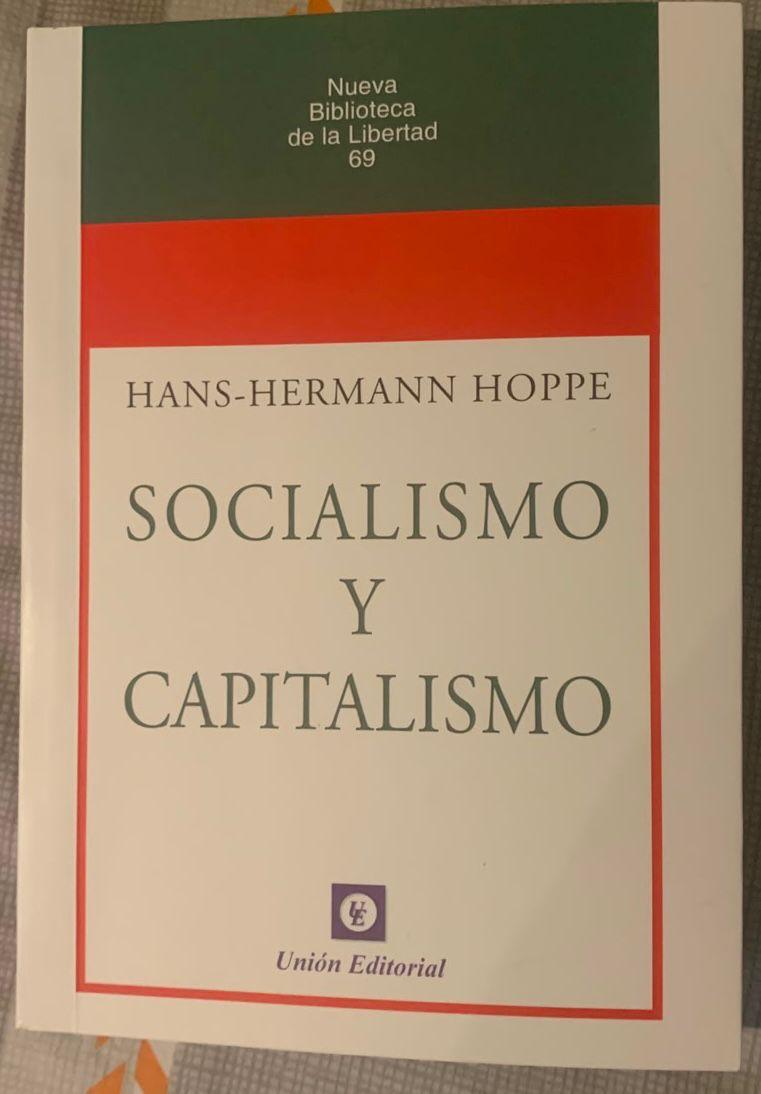
Prof. Hoppe’s seminal A Theory of Socialism and Capitalism was previously translated into Spanish in 2013 as Una Teoría del Socialismo y el Capitalismo, translated and with a prologue by Juan Fernando Carpio (Editorial Innisree, 2013) (see Spanish Translation of A Theory of Socialism and Capitalism). A new edition is apparently now available: Hans-Hermann Hoppe, Socialismo y Capitalismo, Traducción de Juan Fernando Carpio (quien coordina la traducción), junto con Mariano Bas, Daniel Duarte, Dante Bayona y Gerardo Caprav. Coordinación editorial: Gilberto Ramírez. Prólogo de Jesús Huerta de Soto (Nueva Biblioteca de la Libertad 69. Madrid: Unión Editorial, 2026) (hardback; paperback).
A preview containing the Prólogo de Jesús Huerta de Soto is here (pdf); a Grok translation of Huerta de Soto’s Prologue (Foreword) is below. The 2026 translation unfortunately does not include Carpio’s excellent 2013 prologue it is recommended.
From Espinosa:
This year’s book is an improved version based on Carpio’s translation, which I personally arranged with Unión Editorial at Juan Fernando Carpio’s request since 2019, but it’s only now being released. This version makes some corrections of errors in the first translation and also includes footnotes which were not present in the previous translation.
From Carpio:
This is based on my 2013 translation, revised and updated by the editor Gilberto, and printed for Spain and a larger audience than previous edition which was connected to USFQ and Innisfree limited (to South America) and ebook editions, as Spain and Union Editorial command a notably larger area of influence (including LatAm as Spain has leverage over LatAm culturally even to this day as it is still 100-200 years ahead etc).

Descripción:
SOCIALISMO Y CAPITALISMO (Rústica). En Socialismo y capitalismo, Hans-Hermann Hoppe ofrece uno de los análisis más incisivos y sistemáticos sobre las bases morales y económicas del orden social contemporáneo. Lejos de limitarse a una discusión técnica, Hoppe se adentra en la arquitectura ética que sostiene—o socava—nuestras instituciones, y plantea una pregunta radical: ¿qué principios hacen posible la cooperación pacífica y la prosperidad, y cuáles, por el contrario, la erosionan desde dentro? Con una argumentación rigurosa y sin concesiones, el autor examina las distintas formas históricas del socialismo—desde sus versiones marxistas hasta sus variantes socialdemócratas y conservadoras—para mostrar cómo todas ellas comparten un mismo núcleo problemático: la restricción sistemática de los derechos de propiedad. Frente a ello, el capitalismo aparece no como un mero sistema económico entre otros, sino como el único orden social coherente con una ética universalizable de la propiedad privada, capaz de coordinar acciones individuales sin recurrir a la coacción institucionalizada. Este libro no es solo una defensa del mercado, sino una teoría general de la justicia y del conflicto social. Al integrar economía, filosofía política y teoría del conocimiento, Hoppe ofrece al lector una poderosa herramienta conceptual para comprender las tensiones ideológicas de nuestro tiempo. Provocador y profundamente argumentado, Socialismo y capitalismo invita a repensar las categorías heredadas y a reconsiderar, desde sus fundamentos, la legitimidad del poder y los límites del Estado.

Description (translation):
SOCIALISM AND CAPITALISM (Paperback). In Socialism and Capitalism, Hans-Hermann Hoppe offers one of the most incisive and systematic analyses of the moral and economic foundations of the contemporary social order. Far from limiting himself to a technical discussion, Hoppe delves into the ethical architecture that sustains—or undermines—our institutions, and poses a radical question: What principles make peaceful cooperation and prosperity possible, and which, conversely, erode them from within? With rigorous and uncompromising argumentation, the author examines the various historical forms of socialism—from its Marxist versions to its social-democratic and conservative variants—to demonstrate how they all share a single problematic core: the systematic restriction of property rights. In contrast, capitalism emerges not merely as one economic system among others, but as the only social order consistent with a universalizable ethics of private property—one capable of coordinating individual actions without resorting to institutionalized coercion. This book is not merely a defense of the market, but a general theory of justice and social conflict. By integrating economics, political philosophy, and epistemology, Hoppe offers the reader a powerful conceptual tool for understanding the ideological tensions of our time. Provocative and deeply argued, Socialism and Capitalism invites us to rethink inherited categories and to reconsider—from their very foundations—the legitimacy of power and the limits of the State.
Translation of excerpt from Huerta de Soto’s foreword on back cover:
… Hoppe deduces one of the premises that is surely the boldest and most radical in his work and that is transversal to the ten chapters of which it is composed: the ethical and economic inadmissibility of the institution of the State as a protector of private property and property rights. On the basis of this premise, it is understood that the differences between capitalism and socialism are not only of principle (affirmation or negation of the need to protect property rights), but also of degree (affirmation or negation of the need for State intervention in economic and social life). Thus, Hoppe sheds great light on a subject that until then (and even still today) had been deliberately ignored or distorted by economists in particular and by the set of social scientists in general, which is to define the nature of capitalism and socialism.
***
Prólogo de Jesús Huerta de Soto (pdf)
PROLOGUE
The work I have the pleasure of presenting by my colleague Hans-Hermann Hoppe is the first of his mature texts to be published in Spanish, and with it he inaugurates his original—and undoubtedly destined to endure—great intellectual legacy in defense of liberty. Under the original title A Theory of Socialism and Capitalism, 1 Hoppe synthesized one of the most important debates in the history of economic thought: that of conceiving socialism as an alternative to capitalism. This was especially timely because the book was published in 1989, precisely when the experience of Russian-style socialism 2 began to collapse in an unprecedented manner, adding historical confirmation to the debate over its ethical and economic inviability.
In this way, Hoppe not only participated in the early and polemical critique inaugurated by Ludwig von Mises in 1920 with the publication of his article “Economic Calculation in the Socialist Commonwealth” (original German title: Die Wirtschaftsrechnung im sozialistischen Gemeinwesen), 3 but also offered a complete and systematic theory of the organization of society and the economy based on the premise of whether private property and the rights derived from it are respected fully and radically (capitalism), or not (socialism). Indeed, Hoppe is very clear on this from the outset when he states:
Specifically, a theory of property and property rights will be developed. It will be shown that socialism—by no means a creation of nineteenth-century Marxism, but something much older—must be understood as an institutionalized aggression or interference with private property and property rights. Capitalism, on the other hand, is a social system based on the explicit recognition of private property and of contractual and peaceful exchanges between owners. (p. 2)
From this statement, Hoppe derives one of the boldest and most radical premises of his work, one that runs through all ten chapters: the ethically and economically inadmissible nature of the institution of the State as a protector of private property and property rights. On the basis of this premise, it becomes clear that the differences between capitalism and socialism are not only of principle (affirmation or denial of the need to protect property rights), but also of degree (affirmation or denial of the need for State intervention in economic and social life). Thus, Hoppe shed important light on an issue that until then (and even today) has been deliberately overlooked or distorted by economists in particular, and by social scientists in general: the very definition of the nature of capitalism and socialism.
I had the opportunity to incorporate Hoppe’s contributions early on in a contemporary work of my own titled Socialism, Economic Calculation, and Entrepreneurship, whose first edition appeared in 1992. In it, I even advanced a more complete definition of socialism than the one he offered, characterizing it not only as any institutionalized aggression or interference against the right to property, but as “any organized system of institutional aggression against entrepreneurship and human action.” This made the definition of socialism broader and deeper, while implicitly characterizing capitalism as well by recognizing the importance of the entrepreneurial function inherent to human action. Consequently, capitalism would be the free exercise of this function in the absence of systematic and institutionalized coercion (primarily that coming from the State). 4
The need to insist on and deepen the comparison between capitalism and socialism remains especially relevant today, particularly because of the continued vitality of the social-democratic, conservative, and social-engineering variants of socialism described by Hoppe in chapters four, five, and six respectively. These are the variants that most deeply continue to justify State interventions in most countries, replacing the now largely discredited Russian-style socialism mentioned at the beginning of this prologue. Likewise, Hoppe’s solid refutation in chapters nine and ten of the problems of monopoly and public goods in capitalist production remains highly pertinent in the face of the repeated characterization of these phenomena as “market failures” and the implicit justification this provides for institutionalized and systematic State aggression.
Therefore, this translation and edition of A Theory of Socialism and Capitalism by Unión Editorial is undoubtedly a major contribution to Spanish-speaking readers and academia. It continues to disseminate the extraordinary quality of Hans-Hermann Hoppe’s thought and the enduring relevance of the teachings of the Austrian School of Economics, which do so much to combat socialism and, consequently, the statism of all political parties.
Jesús Huerta de Soto
Formentor, July 23, 2025
Feast of Saint Bridget, Patroness of Europe
- Hoppe, Hans-Hermann. A Theory of Socialism and Capitalism, Amsterdam and London, Kluwer Academic Publishers, 1989. [↩]
- As the third chapter of the original work is in fact titled, in which Hoppe reviews the experience of the Soviet Union and what was then known as “real socialism” and its classic model of central economic planning. [↩]
- Its Spanish translation was published in the journal Procesos de Mercado: Revista Europea de Economía Política, Vol. XVII, No. 2, Autumn 2020, pp. 353–388. [↩]
- See, respectively, chapters II (“The Entrepreneurial Function”) and III (“Socialism”) in Huerta de Soto, J., Socialism, Economic Calculation, and Entrepreneurship, 7th ed., Unión Editorial, Madrid 2024. [↩]