 La Grande Fiction: L’État, cet imposteur (Éditions Le Drapeau blanc, 13 Oct. 2016), a French translation of The Great Fiction, with a preface by Guido Hülsmann. Translation by Stephane Geyres below.
Preface
by Jörg Guido Hülsmann
This book was written by a true academic. An academic? Yes, a true academic! This book is a real treat.
But let’s start with the beginning.
The true university entails a free and passionate pursuit of truth by a faculty of seasoned and novice researchers, a pursuit that happens, in particular, by overcoming disciplinary boundaries. The ideal academic is that one who can bring together interdisciplinary and multidisciplinary perspectives on the major issues of their time. This is someone endowed with good judgment. They stand out for their comprehensive grasp of their subject matter and their sense of priorities, above and beyond any technical prowess.
They stand courageously by their convictions. They champion the mind and the fruits of the mind – reasoning, challenge, proof, and truth – against material temptations, against the rush of emotions, and against the arrogance of power. They are scholars who inspire a love of truth and the joy of inquiry in younger generations.
By these standards, Hans-Hermann Hoppe is one of the most eminent academics of our time. He is at ease in philosophy just like in sociology and economics, driven by an untiring intellectual curiosity, armed with a rigorous and incisive mind, endowed with an out-of-par ability to express himself clearly, and strong of a steadfast courage. Hoppe has focused his thoughts and research on the great scientific, social and political subjects of our time. He brought to the field many rich, innovative and deep theses and arguments. We owe him, among others, a bright critique of positivism as the methodology in social sciences, a new – praxeological – approach in political philosophy, a theory of secession as a means for political reform, and a systematic critique of democracy, which raised a great interest internationally, far beyond academic circles.
Inspiring, Hans-Hermann Hoppe has been indeed to several generations of young thinkers, who either had come to discover his texts – if they had not benefited from lectures given by this bright speaker – or were eager readers from the whole world. His works have been translated into twenty-six languages, including French. 1 This edition of “The Great Fiction” is the first one of his works in Molière’s tongue. It brings us a welcome opportunity to introduce the author and his work in France.
Born in 1949 in Peine, Lower Saxony, Hoppe began his academic career in the 1970s. He graduated in history, sociology and philosophy in Saarbrücken and Frankfurt. In 1974, he earned a doctoral thesis in philosophy, which he had developed under Jürgen Habermas’s oversight. Topic was: Epistemology’s praxeological foundations. 1 Somewhat later, he discovered and began to study the advances in epistemology by Ludwig von Mises, one of the major voices of the ‘Austrian School’ of economics. Mises had reached conclusions very similar to Hoppe’s ones. 2
Hoppe confirmed and refined Mises’s core thesis: Knowledge is a particular outcome of human action; therefore, the basic concepts of epistemology are rooted in the basic concepts of the theory of action (praxeology).
Mises left us in 1973. Hoppe never could meet him in person. Yet his legacy imprinted him deeply. The young philosopher from the Frankfurt School, who had been educated as a left-winger, fell for the strictly logical reasoning that he unveils in the words of an uncompromising (classical) liberal economist. Hoppe was further impressed when, shortly after, he became familiar with Murray Newton Rothbard’s writings, Mises’s most important heir. Rothbard proved that the Austrian School’s economic analyses, rooted in the subjective value of economic goods, could be reconciled with the ideas of objective morality and objective political philosophy from the scholastic tradition. Finally, the heavy doors opened. Hoppe changed in political orientation and, over the next years, became a pureblood Austrian and libertarian.
In 1982, he successfully passed a brilliant ‘habilitation’ thesis with this title: ‘Critique of Causal Analysis in the Social Sciences’, in which he furthered the work that Mises and Rothbard had begun: Developing a new epistemology and a new methodology tailored to the specifics of social sciences. 3 This outcome earned him a Heisenberg Fellowship, the most prestigious award for young German researchers, granted by the German Research Foundation (Deutsche Forschungsgemeinschaft). Thanks to this funding, he could move to New York to carry on his research under the oversight of, and more and more in partnership with, Murray Rothbard.
From then on, Hoppe turns his attention to political philosophy. By setting the ‘non-aggression principle’ at the heart of his thoughts, he matures an original synthesis of Rothbard’s theory of property and the ethics of discourse as from Karl-Otto Apel and Jürgen Habermas. 4 His starting point is the observed fact that any justification of a norm necessarily happens within the framework of an argument.
He underlines that whoever argues presupposes a recognized sphere of autonomy in the other party—recipient of the argument—and that such recognition must go both ways for any genuine discussion to take place. In other words, “argumentation presupposes to be the owner of one’s own body”. 5 From this he derives that this “ownership of one’s body [is] a norm that stands as a rule – justifiable by mutual agreement”. 6
He then demonstrates that the opposite thesis entails a logical contradiction. Let’s quote him again:
“Anyone attempting to justify any rule made with the aim of avoiding conflicts over the use of scarce resources would, in their argument, have to presuppose the right to ownership over one’s own body as a universally accepted norm; and reversely, anyone willing to deny a person’s exclusive right over their own body would inevitably find themselves caught in a contradiction. For in so arguing and in seeking approval for their argument, they would implicitly have to presuppose the validity of the norm they dispute.” 7
Here, Hoppe gives us a praxeological analysis of the justification process – it could be called ‘a praxeology of argumentation’. 8
This analysis leads him straight to the harsh conclusion that not any violation of legitimately acquired property rights can be rationally justified, since such a justification would contradict its own logical premises. This result is striking in that it applies just as well to the justification of state activities. After all, the modern state, à la Hobbes, is a monopolist of violence. Hoppe tells us that the activities of this modern state have no way to be justified. Their legitimation is therefore illusory, in opposition to what Max Weber and so many other theorists had implied. Only a social order exclusively grounded in the principles of private law (reine Privatrechtsgesellschaft) can be justified out of any logical contradiction.
Only a free society, resting on property rights, rightfully acquired, with its economic materialization – the free, capitalist economy – can be justified without any contradiction.
Hans-Hermann Hoppe is quite fearless when it comes to pointing at the radical political implications of his analysis. This intellectual courage comes at a price. In the deeply statist Germany of the 1980s, he lost any chance of an academic career.
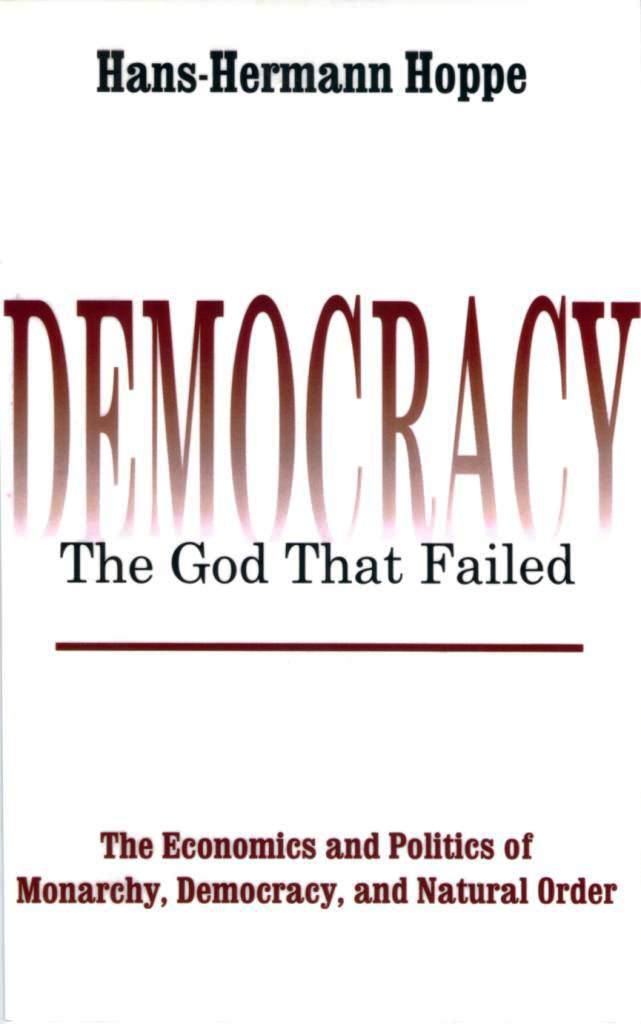
But he is already no more in Germany. In 1986, he becomes Rothbard’s colleague at the University of Las Vegas and begins to forge a name for himself in the United States. Over the next fifteen years, he has published, among others, three major treatises: “A Theory of Socialism and Capitalism” (Boston: Kluwer, 1989), “The Economics and Ethics of Private Property” (Boston, Kluwer, 1993) and “Democracy, the God That Failed” (New Brunswick, Transaction Publishers, 2001). 9
First, he presents his earlier thoughts on the methodology of the social sciences and the justification of political norms to the English-speaking audience. Second, he revisits his analyses of the market economy and of interventionism, this time putting more emphasis on their economic and sociological aspects. In the first two books, he focuses on economic issues, such as the theory of public goods as well as monopoly theory and taxation theory. In contrast, in his critique of democracy, Hoppe presents quite a broad insight, one going well beyond the confines of economic analysis.
He explains why the incentive structures prevailing in democratic regimes create an environment particularly conducive to the excessive expansion of the state; he brings afore that many symptoms of cultural decline have their main root cause in the democratic shift of politics; he undertakes a relentless analysis of the mistakes of the classical liberals of the 18th and 19th centuries; and he discusses the options for political reform through secession.
Hoppe also underlines the importance of a point that had been made by Bertrand de Jouvenel: a major drawback of democracy lies precisely in its ability to make power accessible to everyone. 10
The tension between those in power and their subjects is thus pacified. Leaders of ambition, even if subjects of the state today, can fancy themselves as rulers tomorrow; therefore, their interest is in fact not in reducing the power of the apparatus they hope one day to control. This mesh of incentives freezes any radical criticism of the political institutions, especially when it comes to limiting the scope of the state. The resulting long-term trend is in an even more systematic exploitation of the population by the political caste.
Analyzing democracy in Jouvenel’s and Hoppe’s vein brings a retrospective explanation for the fact that even in traditionally autocratic Russia there had been a political system change as early as 1991; whereas nations usually more (classic) liberal than Russia, such as France or Germany, still find themselves trapped in the decaying spirals of state interventionism. The explanation is that the Russians had the benefit of not falling very long for the spell of democratic illusions.
On top of the major books listed above, Hans-Hermann Hoppe has published numerous shorter studies over the last thirty years, focusing on specific issues such as methodological questions, the theory of risk, the production of security, the history of ideas, the reform of the socialist states of Eastern Europe, and the evolution of monetary institutions together with their link with international finance and trade. Among his most valuable contributions is his analysis of the issues resulting from migration, where he underlines that, within a free economy, free movements of people must not be confused with state-subsidized free movement of persons. 11 Likewise, his analysis of the role of intellectuals in the political transformation process has raised much attention and a strong international response.
He stresses the vital role of ‘anti-intellectual intellectuals’ who, being independent of the state, would be able to guide the de-statization of communities and civil societies. 12
It is papers of this kind that are brought together in this volume. “La Grande Fiction” reveals Hans-Hermann Hoppe with his very accessible tone: an author who writes with skill, realism and courage. Courage, above all. This is probably what strikes the reader who discovers him for the first time. Not only does he have the courage to tackle sacred cows and golden calves, but to top it all, he clearly takes pleasure in hammering them many times before leading them to the slaughterhouse.
When Murray Rothbard passes away in January 1995, Hoppe finds himself increasingly isolated in Las Vegas. For a time, while keeping his position, he grows closer to the Ludwig von Mises Institute, which Lew Rockwell had been running in Auburn, Alabama.
Then, in 2006, he leaves the United States and starts a new life in Turkey. Together with a handful of friends, he creates an international libertarian network, the Property and Freedom Society, which holds annual conferences. These gatherings are dedicated to lectures and debates on topics close to the founder’s heart, and to slaying golden calves.
Today, Hans-Hermann Hoppe is the undisputed Dean of the Austrian School of Economics. He owes his reputation not only to his academic achievements, but also to his teaching talent and his outstanding personal qualities. Anyone with the good fortune to meet him holds him in high regard for his honesty, his humor, his warmth and his unwavering loyalty, also for his passionate love of truth and freedom, no less than for his unmasked contempt for arrogant stupidity and for cowardice. Besides, such virtues are obvious in the next pages. Hoppe is anything but indifferent to the topics he addresses. This is the promise of an interesting read.
Enjoy yourself!
Guido Hülsmann
Done in Angers, France, April 2016.
- Hoppe (Hans-Hermann), “Handeln und Erkennen. Zur Kritik des Empirismus am Beispiel der Philosophie David Humes”, Berne, Peter Lang, 1976. [↩]
- Ludwig von Mises, “The Ultimate Foundation of Economic Science”, Irvington-on-Hudson, Foundation for economic education, 1996 (1st ed. : 1962), chap. II, section 1. [↩]
- Hoppe (H.-H.), “Kritik der kausalwissenschaftlichen Sozialforschung. Untersuchungen zur Grundlegung von Soziologie und Ökonomie”, Opladen, Westdeutscher Verlag, 1983. [↩]
- See Habermas (Jürgen), Theorie des kommunikativen Handelns, Francfort, suhrkamp, 2 vol., 1981; and Rothbard (Murray Newton), The Ethics of Liberty, New York, New York University, 1998 (1st ed.: 1982). An argument similar to Hoppe’s can be found in the work of two lawyers, Frank van Dun and Stephan Kinsella, as well as by philosophers G. B. Madison and T. Machan. See Kinsella (Norman Stephan), “New Rationalist directions in Libertarian Rights theory”, Journal of Libertarian Studies, vol. 12, no 2, 1996. [↩]
- Hoppe (H.-H.), “Eigentum, Anarchie und Staat. Studien zur Theorie des Kapitalismus”, Leipzig, Manuscrptum, 2005 (1st ed.: 1987), p. 96. [↩]
- Id. [↩]
- Id. Original in German: “Jeder, der versuchte, irgendeine zum Zweck der Konfliktvermeidung im Hinblick auf knappe Güter formulierte Regel zu rechtfertigen, müßte, indemer entsprechend argumentierte, das Recht auf Eigentum am eigenen Körper bereits als eine allseits gerechtfertigte Norm voraussetzen ; und umgekehrt müßte sich jeder, der das exklusive Verfügungsrecht einer Person über ihren Körper bestreiten wollte, notwendig in einen Widerspruch verwickeln, denn indem er so argumentierte und für sein Argument Zustimmung suchte, müßte er bereits implizit die Geltung der von ihm bestrittenen Norm voraussetzen.” [↩]
- In an excited comment on Hoppe, Murray Rothbard went so far as to claim that the latter had he has “managed to transcend the famous is/ought, fact/value dichotomy that has plagued philosophy since the days of the scholastics, and that had brought modern libertarianism into a tiresome deadlock” (“Beyond Is and Ought”, Liberty, November 1988, p. 44). Likewise, according to Stephan Kinsella, Hoppe’s theory would be a “discussion ethics” (argumentation ethics) (“The Undeniable Morality of Capitalism”, St. Mary’s Law Journal, vol. 25, 1994). This interpretation is abusive. Hoppe insists himself that his goal is not to justify normative statements. He shares the common view that it is impossible to derive a normative statement from a purely factual analysis. An ‘is’ cannot imply an ‘ought’. [↩]
- Available in French (Title : « Démocratie, le dieu qui a échoué ») here : bit.ly/hhh-democratie. [↩]
- Bertrand de Jouvenel, « Du pouvoir », Genève, Constant Bourquin, 1945. [↩]
- Hoppe (H.-H.), “The Case for Free trade and Restricted Immigration”, Journal of Libertarian Studies, vol. 13, no 2, 1998. [↩]
- Hoppe (H.-H.), “Natural Elites, Intellectuals, and the State”, Auburn, Mises Institute, 1995. [↩]