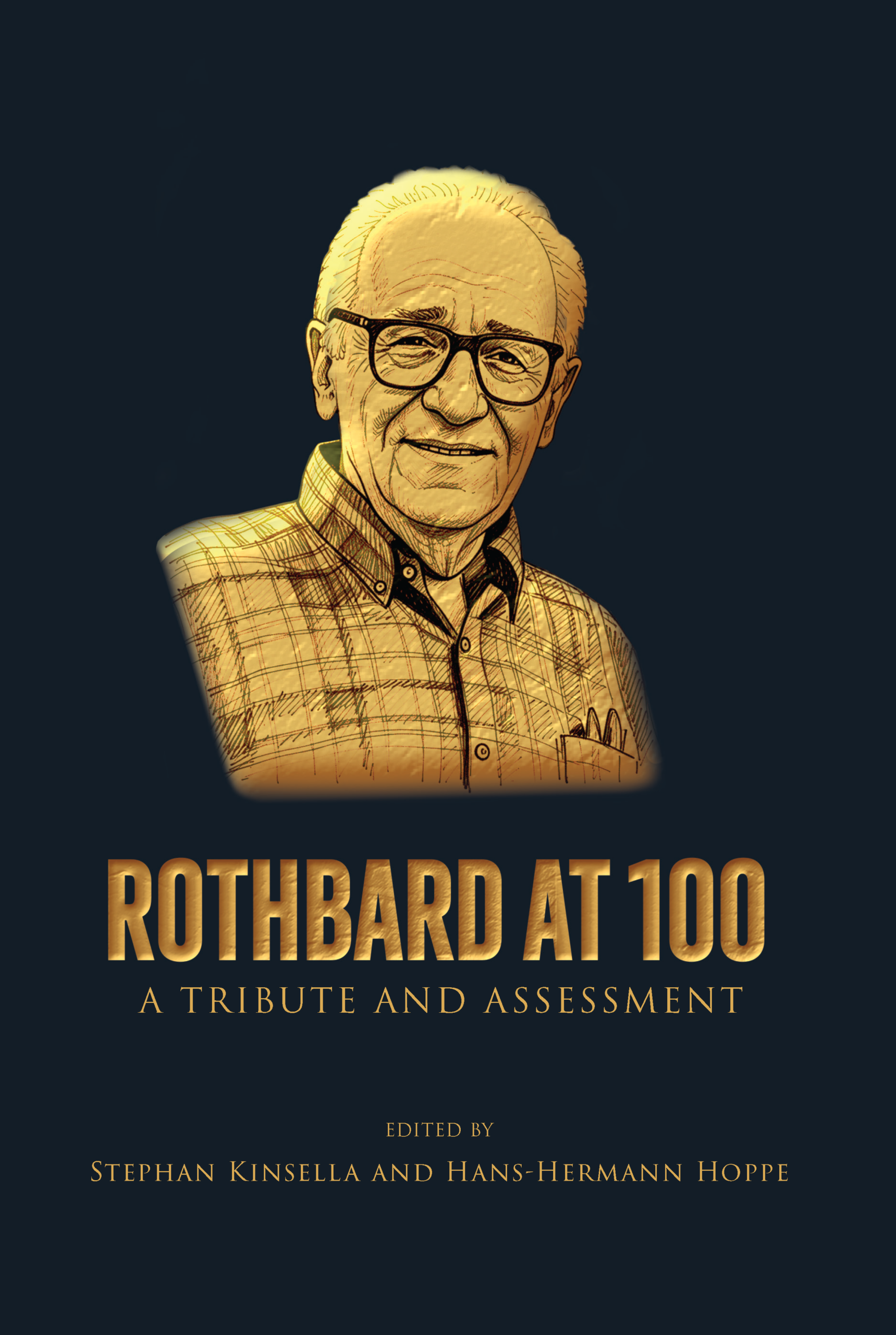
Hans Hoppe e a insustentável defesa do Estado (LVM Editora, 2019) (“Hans Hoppe and the unsustainable defense of the State”) has just been published in Portuguese. This work is part of a collection aimed at popularizing the thought of various great thinkers organized by Prof. Dennys Xavier. The volume on Professor Hoppe’s thought is the fourth in the series; the others in the series so far include volumes on Hayek, Ayn Rand, and Thomas Sowell.
 What Must Be Done (2009, based on a lecture delivered in 1997) has been translated into Portuguese as part of a pocket-book collection as O que deve ser feito (LVM Editora, 2019; translation by Paulo Pozonoff, preface by Rodrigo Saraiva Marinho). [Rothbard Institute version]
 A previous translation by Fernando Fiori Chiocca was previously published in 2013, and is available here.
Speech delivered in German on 23 November 2019 at the Palais Coburg in Vienna, Austria, at an event commemorating the 70th anniversary of the publication of Mises’s Human Action. English translation by Robert Grözinger
My Path to the Austrian School of Economics

[This talk was delivered 23 November at the Palais Coburg in Vienna, Austria, at an event commemorating the 70th anniversary of the publication of Mises’s Human Action.]
Nowadays, it’s not uncommon for people as young as 20 or 30 to feel they have to share their memories with the world. Even at an advanced age, I prefer not to talk publicly about personal things and experiences in my life, but to reserve this for private conversations.
[continue reading…]
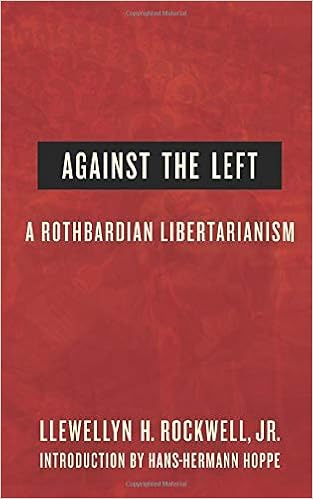 Preface to Against the Left: A Rothbardian Libertarianism, by Llewellyn H Rockwell Jr. (Rockwell Communications LLC, 2019).
PREFACE
by Hans-Hermann Hoppe
Every person, including identical twins, is unique, different from and unequal to all other persons. Everyone is born at a different time and/or place. Everyone has two different, older and unequal biological parents, a male father and a female mother. Every person, throughout its entire life, faces and must act in a different and unequal environment with different and unequal opportunities and challenges, and every person’s life, its accomplishments and its failings, its joys and satisfactions as much as its disappointments, sorrows and sufferings, then, is different from and unequal to that of everyone else. Moreover, this natural inequality of any and all human beings is still greatly amplified with the establishment of any and every society based on the division of labor. [continue reading…]
This is an interview of Dr. Hoppe by Mikhail Svetov (Михаил Светов) for SVTV (SVETOV TV) on Nov. 3, 2019. From the shownotes:
Conversation with dr. Hans-Hermann Hoppe about corrupting money in politics, perils of democracy, split between Cato Institute and Rothbard, freedom of association and getting libertarianism right.
Svetov was the organizer of his recent trip to Moscow [see also “Historical Patterns and Tendencies from an Austro-Libertarian Perspective”: Hoppe in Moscow; Hoppe, On Getting Libertarianism Right].
Transcript below.
Unedited Transcript from Youtube
if you say these sorts of things that I said here you are not sure anymore that you will have your job in the United
States for the next day there’s more and more classical liberals calling themselves other carryings part of the
reason is of course that people don’t read much they are lazy if you read for it since iyx most famous book there is
such an extensive list of things that the state should do that Swedish Democrat would easily be able to agree
with all of it I have come to the conclusion in the meantime unless you have been frequently attacked to be a
sexist of homophobe crisis and you should ask yourself if there’s something
wrong with you listen we only have one child we don’t want another child because a second
child will be an additional problem for world climate and so forth you can reduce a problem by one if you just
simply kill yourself on the spot the draft the Dominions about my health
yet of stimulus Jergens German hope after National Committee Democrats in is Ernie Boch Peguero missionary
libertarians to purchase name discriminate so Adam privately in approval interpreter roots a libertarian
story at own caucus ports of pre howtechs abenomics tone I believe it’s even really Hoyer
[Music] Thank You Huns for coming to my show and
I guess the first question is how did libertarianism became about and how is
it different from classical liberalism maybe I should just say a few words
about myself and how I became a libertarian myself when I was young I
was a lefty I grew up in the late 1960s
and when I started my studies in 1968 that was a high time of the student
rebellion in Europe and my principal teacher at that time in philosophy that
was my first field was you can have a mass who was worldwide probably the most
prominent left-wing philosopher realized quickly the loopholes in the leftist
doctrine and was on the look out for some alternatives and followed the
newspapers for alternatives I first discovered Milton Friedman they quickly
discovered certain inconsistencies in his work then from Milton Friedman I
encountered really Hayek who was well known especially in in Germany because
he was Austrian and won the Nobel Prize in 1974 again I discovered many mistakes
in Hayek very quickly and then through footnotes that I found in Hayek I
discovered Ludwig von Mises who was one of Hayek’s teachers and I thought that
Mises was a far superior thinker over-over Hayek and from would be for
Mises I discovered very quickly his most famous Americans and Mary Rothbart I went in from Germany
to the United States to work with Rose Bart and I spent the 10 last years of
force Bart’s life in close cooperation with him
Mary Rose part is the founder of the modern libertarian movement there would
be no libertarian movement without Mary Rose apart and I was for the last 10
years of his life I was his right-hand man so I knew him better at least at the
end of his life than than anybody else so I did not know anything about the
libertarian movement in the United States but I was I was a CEO at issue
I have always been a theoretician I have never been involved in Libertarian Party
activities I was of course aware that they exist a libertarian party and I
went to two or three events that they organized that but that was just not my
natural inclination I was somebody who worked in his study and wrote and and
read I thought it was somewhat of importance to show that I did not grow
up in the United States I was not involved in the libertarian movement from the very beginning it was strange
to me when I came there I was happy to discover that they existed something
like this but I was never really heavily involved in it even though in the course
of my life of course I met almost all people who had some name mostly through
the connection that I had was rose bard who knew of course all the people and in the course of the years I met almost all
leading figures myself too so my question was how did libertarianism came
about how was it different from classical liberalism and why didn’t just old ideas prevail while why we we deem
Rothbart to be the author of modern libertarianism a major reason for that was
that the term liberal in the United States had assumed a completely different meaning than it had in Europe
in Europe liberals or people who were in favor of free-market economy and a very
limited state some of the more radicals or in favor of what is called a night
watchman state where the state doesn’t do anything else but make sure that the
police does its work and the courts do its work and that’s the end of the
engagement in the United States however liberal has a meaning of a social
democrat the democratic party in the united states are referred to as liberals but they have nothing to do
with classical liberalism as it existed in europe and because of that i think
there was a need to look for a new term and in the course of looking for a new
term and also a radicalization of classical liberalism occurred not with
all people who afterwards called themselves libertarian but with people
like mary rose part in particular where rose part was initially a musician in
the sense that Mises wanted to have a minimal state a state that doesn’t do
anything else except for this force external defense and a judiciary
raus part then radicalized this and by pointing out that even a minimal state
does of course require taxation in order to be financed and thought that that was
a violation of basic moral principles namely the principle that you should not
against other people and take the property of people who have just be
acquired their property so he made the step to what is called now
anarcho-capitalism which is a radicalized version of classical
liberalism his view was that even the function of judges the function of
defense the function of police forces can be done better by competing
organizations than by some monopolist that relies on taxation people do want
to be protected in their private property why don’t they turn to private companies
that offer our services I want to protect your private property all you
have to do is sign a contract with me I offer this service you don’t have to
sign up with me you can also sign up with other people who defend yourself so
his view was there is nothing that private enterprises cannot do better
than the monopolist provider such as the state now the Rose Park program is still
probably the most powerful program of libertarianism in the United States
however they are also quite a few people who remain in Hawaii classical liberals
but not calling themselves in the United States classical liberals also adopting
the term libertarians but who refused to
accept Ross part’s radical conclusion everything has to be done by private
enterprises they thought now certain things have to be done by by the state
nowadays classical liberals in Europe still have affinity to the
Libertarians in the United States and in the United States itself you have so to
speak to wings among the class among libertarians those who are anarchists
and those who cling to the classical traditional European way of the minimal
of a minimal state so if Rothbart used to be regarded as a founding father of
modern libertarianism why did departure from the authority and tradition of libertarianism happen because today when
you talk to libertarians in the West what you face is that you know there’s more and more classical liberals calling
themselves libertarians and the authority and traditions seems to be like taking the backstab why did it
happen part of the reason is of course that people don’t read much they are
lazy and the more acceptable version is of course a classical liberal version
the idea that the state is necessary somehow is so ingrained in the heads of
people that they could not free themselves of that of that preconception
and the other reason is indeed that the bigger this movement guru the less worse
was a number of people who actually read a lot of things they were satisfied with
just getting a few slogans and that was enough whereas I think the the major
seer additions of the libertarian movement as far as I can tell are all
anarcho-capitalists because the classical liberals do have a tremendous
difficulty explaining how if you have the minimal state that is a monopolist
to decide how many resources do we need in order to do our minimal tasks
of defending people protecting their private property there is no end to it
as I do we need hundred dollars from per person to this do this 150 or 200 or 300
or 1000 there is no answer to this question worse if you say you don’t need
anything then you have of course a very clear answer to this question it’s a
little anecdote I can tell use it at the beginning you probably come back to the split
between various organizations in the United States at the very beginning the
Mises Institute was also reluctant to come out openly in favor of of anarchy
because Jesus had made some remarks about feeling uncomfortable with term
but Mises was as a European of course influenced by European types of
anarchists who were mostly syndicalist anarchists not private property and our
kists and rejected them on the other hand Mises for instance in his earlier
works pleaded for the right of every community to secede from its larger
entity so he said even if a small village wants to secede from the country
as a whole they should be free to do that and if an individual wants to
secede from that small village if that might not be very practical but if it
can be done that also should be permitted and by saying this came of
course extremely close to the idea that that was part promoted and the two of
them as rosebud was of course far and visas were always on good terms and
and Mises wrote glowing reviews of of
rose Bart’s main main works
you mentioned the split between other charity institutions and you mean displayed between the Cato and the
Missis Institute what happened why did this split occur because I think few people realize in Russia definitely very
few people realize that the Rothbard actually founded both Institute the Cato and the Mises Institute and the reason
why the Misses Institute was created is because there was some sort of conflict that made Rothbard leave the Cato so
what happened yeah it was initially Ross
part was friends with the Koch brothers especially I think Charles Koch and the
Koch brothers are the largest privately owned company in the United States they
are mostly in oil and oil in the oil business up to this day they belong to
the 10 10 wealthiest people in the United States so Charles Koch was
initially an armored by the ideas Ross part promoted then they had a fallout I
put it this way Koch was so to speak the money giver and Mary Ross part was the
intellectual head of the outfit when the Cato Institute was founded
mary-rose part became a share owner in
indicator Institute but then the Cato Institute decided to move from the west
coast was he were initially located in San Francisco to Washington DC and they
wanted to become politically influential and in order to gain political influence
they thought then it would be beneficial if instead of which was Ross parts idea
promoting mostly Mises that they would promote instead Friedrich Hayek with a
far more moderate sinker if you read for instance the
constitution of Liberty which is one of Hayek’s most famous books it was
published in the 1960s if you look at the third part of that book where he
discusses what would be the appropriate functions for States there is such an
extensive list of things that the state should do that a Swedish Democrat would easily be able
to agree with all of it Mises of course was or people called
intransigent but an extremist he didn’t make any compromises that no there
should be there should be no function of the state besides his few that I
mentioned early on so Mises was de-emphasized because he was considered
to be politically intelligible and Hayek was promoted and that led them to a
split rose part refused to do that and said if you have me as your head I want
to promote the Mises line and I’m not in favor of the Hayek line he even said as
a great danger to choose Hayek as a promoter of libertarianism free market
stuff because all the enemies of classical liberalism and libertarianism
will point out to Hayek’s book constitution of Liberty and say yeah but
you see even this promoter of liberalism and libertarianism he allows the state
to do this he knows estate to do this and he allows the state to do this this
is precisely what happened and what then happened was when Ross part insisted
that that should not be done then the house that him from the Cato Institute they robbed him
of his shares he was silly enough as he admitted afterwards that he had his shares stored
at the Koch headquarters in Wichita
Kansas and the Koch brothers and told him sue us if you want and of course the
response it was a poor academic so how are you going to sue multi multi
billionaires who can sue you back for 10 20 30 years and he gave up and then
after he was ousted from the Cato Institute the Cato Institute and became
a relatively moderate institution that tried to do lobbying work in Washington
DC then Lou Rockwell who had been a book
editor and published some of Jesus’s books approached Ross part and the widow
of Ludwig von Mises with the idea
I will found a Mises Institute that continues the work that originally the
Cato Institute was supposed to do when that happened the Cato Institute and
they are fine and Sears again you have to imagine that these guys had almost
unlimited resources they then started a campaign against the Mises Institute the
Mises Institute had to be destroyed they’e wrote to all potential donors
don’t give any money to that Institute these people must be eliminated they
must be destroyed – Noah to no avail I mean it was difficult I have been
associated with the Mises Institute almost from the very beginning I was founded in 1982 I moved to the
United States in 1985 I worked with Ross part first in New York City for a year
then we post moved to Las Vegas of work colleagues we had our offices right next
to each other we had initially Muse Institute had maybe a handful of
employees and and the Ross part as his
intellectual head me as his assistant and involved a block somewhere in the
background as well that was that was it in the meantime of course the Mises Institute is quite big they rely on
donations from small donors but a large
number of small donors which makes you more independent because big donors tend
to insist no this one topic I don’t want
you to talk about this this is what I want you to do small donors they have no
power over what the Institute does I remember there were cases for instance
when moderately sized donors for
instance approached Lew Rockwell and said Luke get rid of this Papa guy he is
too radical we don’t want him and we don’t give you money anymore if you
don’t throw him out and Lou Rocco no way will I do this your contributions
are certainly not big enough to make me a stupid decision like this if you have a billionaire who says this sort of
thing and if he is not satisfied with your decision then you at the end the
same then you have no funds whatsoever anymore so the fact that the Mises Institute succeeded was due to the fact
that large numbers of comparatively small donors sustained sustains the Institute and
they have stayed true to the Ross pardon
the rose bargain program no other institution has done that and I did play
a role in persuading Lew Rockwell to give up this idea of we are in favor of
limited government and I was refusing to say now we are a narco capitalist but by
simply pointing out Lou is there any institution that says that they are in
favor of unlimited government and he said of a thing no there’s not a single
institution that I’m in favor of unlimited government so say so if you
even from a marketing point of view you had to say no we are not in favor of
unlimited of you’re not a favor of limited government everybody is in favor of limited government we are in favor of
no government at all so was this the Koch brothers they are still one of the major sponsors of all the libertarian
organizations in the West so would it be proper to say that big money corrupted
the libertarian movement yes of course that would be true and it was not the
Koch brothers did not only fund the Cato Institute they fund Marc Marc Marc a DOS
Center partner large parts of George Mason University the Economics
Department who is is funded by by the Koch brothers in their policy up to this
day is to make sure that there should be no mention of Ross part or if there is
any mention of Ross part it should be in a negative in a negative way I had
friends for instance who were associated with the Cato Institute and when they
wrote articles were they cite at me they were immediately dismissed as engines of
of the case Institute there are journals so-called Austrian journals some of my older
students told me they had submitted articles to that to the journal and and
the editor insisted but any reference to the name of hope that you have to take
out otherwise we will not publish we want to publish that article they they
actually employed people with no other purpose then traveling around the world
to all sorts of libertarian gatherings with a task of maligning spreading evil
rumors about Ross part and me to not to no avail
I never cared about it I never replied to any of these things and Ross part and
I became more and more successful despite all of these attacks that we
that we had to endure to this to this very day and what do you think is their goal I mean why are they fighting for
the limited government isn’t because if there is a government big money can Lobby their interest to it because you
can’t really love in the market you can only Lobby the government we imagine
that you that you are a Mises Institute representative and and ask yourself how
many of these washing higher-ups would invite you and have conversations with
you on the answers they are not interest to talk to talk to us we are not interested to talk to them because we
know it will be all to no avail whatsoever but if you want to be invited
to the right cocktail parties and no prominent people I have met Bush I have
met Obama I have met whatever some of
these Fox Fox News reporters and so forth then then you must be willing to make
these compromises and that’s what the Cato Institute and all their representatives do they are extremely
proud about all the all the big shots that they’d that they know whereas the
big shots don’t have much interest in in meeting Mises Institute people
[Music] there’s a case of Ron Paul for example
who is a pariah in the Cato Institute circles for pretty much the same reasons because he always preached not just
limited government but a wrath Bornean review of libertarianism and he was quite successful in those kind of
circles that you’re talking about at the same time well I mean he was he was
elected a few times to the House of Representatives from his local
electorate but he was an outsider in in Washington he was well-known as as dr.
know because every legislation that was proposed he was the only one who said no
I’m against this Ron Paul was in the
political establishment serving the person who was the most vigorous
opponent of the Federal Reserve of the American central bank which made him an
outcast in addition I should point out that Ron Paul was of course also the
person who made remarks about the blacks
commit more crimes and whites there are a certain certain dysfunctions that go
on in some sectors of the American society and was then immediately
attacked as a racist in America in the meantime everybody who ever says not
everybody is equal there are people that are black and they’re people who have slanted eyes and
then there are Caucasians and then there are women and there are men and men and
women are not just the same and blacks and whites just differ in many respects
anybody who opens his eyes and says these things that are obvious to every
person who lives in the United States is considered to be a racist
I have come to the conclusion in the meantime unless you have been frequently attacked to be a sexist of homophobe a
racist or something like that unless you have been frequently attacked I said then you should ask yourself if there’s
something wrong with you because that is every normal person according to this
new doctrine of political correctness is every normal person is a racist of
homophobe anti anti women and whatever it is the
only the only people who are responsive for every evil thing ever happened in
the history of mankind are white heterosexual males so keep in mind that
you can afterwards go to all these guys here and tell them that everything bad
that ever happened in your life to you is due to the fact that these evil white
heterosexual people are oppressing you and have oppressed you for thousands and
thousands of years so anybody who has common sense is in the United States in
the meantime attacked if you say these sorts of things that I said here you are
not sure anymore that you will have your job in the United States or the next day they will not jail you for this in
European countries saying certain things they even jail you that they don’t do in
the United States you can still say whatever you want but if you still have
your jump on the next day that is an entirely different question so how did
the left manage to dominate the public discourse so efficiently for so long to
to have the kind of influence that you just described I think that is the
popularity of egalitarianism for most people it is difficult to admit that
people are very even though it is obvious that people are very different that
there are some people are very good at doing certain things and other people are not so good that there are sex
successful men and women and losers that
there are some groups in the world that have accomplished more and other groups
have accomplished less nobody likes to hear that that you are not as good at
such and such as this guy is why are the white heterosexual males attacked so
much yeah because if you look at in what places in world history were the
greatest civilizational achievements achieved and that is is white
heterosexual male societies are the ones that are the most successful by far
compare that was was Africa compare that with the Middle East so they cannot
tolerate the fact that they have to admit that these people must have done
something right and we must have done something wrong why are they so much
more successful and why are we not as successful so aren’t you tapping into
the same kind of emotions that the left is do when you talk about you know how white heterosexual male you know are
being oppressed by the modern society aren’t you talking to the losers of the current political situation and tapping
into this sense of being a loser to help people organize maybe but you’re tapping
into the same kind of emotion I appeal to emotions of people that I think are
essential in order to improve life and
the living conditions of everyone you
they are after all the promoters of
civilizational progress the should be hailed and they should just be
self-confident enough to say look what we have done is quite exceptional we
have done many wrong things maybe but nonetheless look where you would be
without us we are the ones that you should emulate you should admire what we
do instead of attacking us and if you admire us and recognize what role we
played you all will benefit in the long run from this instead of attacking those
people who are the guarantors of
continuing prosperity for those people who think that they got the short stick
in life but you’re talking from the position of the moral superiority in
that case I’m I’m no I’m simply pointing
out effect to who do you owe your standard of living to whom do you owe
your great freedoms that you have you
should not cut down those people who played the most important role in
assuring and guaranteeing what you currently have and are the best
guarantors for future for for your future progress if you look ask yourself
the question who can who created libertarian and liberal ideas who were
the main writers that we look upon who realized how important private property
is priests and the protection of private property is especially also for the poor
people then you come to the realization those were very few people mostly male
mostly in Western countries and hardly anybody was a major liberal thinker a
major libertarian thinker contributing anything to this movement to this
worldview coming from other areas of the world not that they didn’t have any but
almost none so there should be an appreciation of those traditions that
made the West great I mean Jesus was right when he said the
idea of freedom is the Western idea that has never existed to the same extent in
any other part of the world except in Western societies Western societies are
not responsible for the plight of India and Africa as of course quite to the
contrary if these countries have ever any chance to get out of their
disastrous situation in which they are then the only way to do it is to adopt
Western ideas but if you listen to what the left has to say they’re actually questioning your entire preserved
precision they questioned the validity of the argument that what we have today
the society that we have today is something of value that’s their main point they can choose to live in other
countries if you want why don’t they move into Inyo Africa if they are so
unhappy with material wealth I mean it is easy to downgrade all this as you
know only materialist material wealth and all the rest of it but if you are so
concerned about that then there are plenty of places in the world where you can go but they don’t they don’t go
there and just say but where are the people trying to move to there’s there’s
no mass migration movement from Africa country to India there’s no mass
migration movement to Southeast Asia the mass migration movement is to countries
that are wealthier and it should be recognized that they are wealthier for a reason they say we shouldn’t have to
move we are the victims here where the victims of your oppression and what you
present as civilization is actually this story of oppression of of whatever
whatever we value as a value okay most of society’s until about 1800 lived in
the Malthusian age that is the growth of population outstripped the increase in
productivity that is what Malthus described is no longer true but it was
true until about 1800 again to repeat if
the population increases and of course before you had birth controls and things like that the population dramatically
increased sometimes but you can feed an increasing population only if you have
at the same time economic growth if you have productivity advances that make it
possible that additional people can also be fed until the 18th century you had
throughout the entire world massive amounts of people dying off because the
economy did not allow everyone to to survive so the Western societies drew
themselves out of this threat it was not because they exploited any any other
society whatsoever because there was nothing to exploit from these other societies they were also poor since that
time we have growing population to us increasing general standards of living
on a worldwide scale they have never been as many people for eat
of extreme poverty as in the last 200 years you can only say they exploited
their own workers but the problem there is of course the workers could have
become capitalists themselves they decided not to become capitalists themselves because it had to require
that they had to wait far longer before they would ever be paid wages they
decided I want to become controi because as an employee I will become paid right
away or if I become a capitalist myself I first have to build all the capital
goods and have to wait until the capital goods are already in turn out consumer goods and only then do I collect any any
income but even the claim that we’re feeding more people than ever that we can feed the growing population is under
attack today and if you look at the greta Sundberg what she was saying in the united nations just a couple of days ago how dare you she’s attacking this
exact idea that there’s you know that there’s too many of us the the situation
cannot be sustained and that you were selling that’s what they say that you that we’ve been selling them alive oh so
you think the people who have that fear I always tell look you you can reduce a
problem by one if you just simply kill yourself on the spot then the problem is
already one one person less so you I mean you have like Prince Harry and
whatever this Megan girl so they said we only have one child we
don’t want another child because a second child will will be an additional
problem for world climate and so forth then the question why did you even have the first child what why didn’t you kill
yourself on the spot then the problem is a little bit less and the greens and all
of these people are not in favor of population control in Africa Africa is
the continent where you have enormous growth rates of population Russia is a dying
population I mean the the number is declined in Germany Germany is declining the only people that the only fact that
it doesn’t decline is that because of the emigrate the mass emigration that
takes place which all go on welfare in in Germany there is practically no
European country that has that the native population even maintains the
same size the Western societies are by and large dying out so we do what
greater tune bird wants us to do except that she doesn’t kill herself the countries that are as a major danger
are precisely those the African countries with enormous they have five
kids ten kids no problem normally but but but this is not made to make into a problem quite to
the contrary we are the ones who are responsible for all of the evil things that go on in these in these places even
though according to their own doctrine they are the main problem that they just simply can’t curtail their population
girls so how did the write lose out on the
public discourse how did how did the write lose the popular support yeah that
is a very very interesting question is this when has something to do with the
transformation officer of the left the traditional left the traditional Marxist
type of left they want to do means of production have to be socialized and so
forth and since that turned out to be a disaster after a while people realized
to join if they wanted to be create more prosperity than in the West and of
course if everybody could see that that was not the case so then they had to
change their to change their doctrine and they adopted this cultural cultural
Marxism and attacked traditional
institutions like families infiltrated all cultural institutions and worked
heavily with intellectuals we have to realize that intellectuals are a very
dangerous very dangerous people intellectuals have difficulties making
money who is interested in in getting advice listening to speeches reading
books most people have completely different interests but watch TV get get drunk try
to look for girls and all that sort of stuff and or tired when they come home
from work there is a very limit that demand for intellectual services
I mean writers and philosophers and economists and whatever it is so these
picked these people they were taken over by the state made all be turned into
state dependents and they realized that they have to
promote these sorts of ideas in order to secure their own position
they formed alliances with the state so would be accurate to say that the the
government force was used by the special interest group to dis acure their own privileged privileged place in the
society to to corrupt the actual society that they came from yes I want I would
say that nowadays at least in the Western societies people spend almost
thirty years of their life in government
institutions so first you go into kindergarten that’s a government institution then you go to school in the
old days that was only four or five years and it was nine years then it was thirteen years in the mean time they
also promote the idea that everybody has to go to the University even though most
of the people are not made for university studies because most of the
people are incapable of doing serious work at the university and I tell you
why I taught for 25 years at American universities in I mean what low quality
of students you get there is unbelievable English is not my native language but when I came to the United
States and I asked Americans to write essays I felt like I was Shakespeare as
compared with what what I saw there and I stopped very quickly to give them
essay questions and resort it and only to to false questions because first of
all it was easier for me to grade and I and I simply didn’t want to do this to
me to read this gibberish that these people were writing so you have yet
I might be 60 to 70% of an age group in the United States that goes to universities that mean they are not the
population in America did not get smarter I mean dump people are now admitted to
to the universities and then they invented new fields like Black Studies
Women’s Studies Hispanic studies gay lesbian studies and then and you get a
degree in in black gay lesbian artistic Studies or something like this and have
a degree the longer people spend in educational institutions the more they
vote for left idiotic things the most reasonable people are craftsmen plumbers
electricians people who who know something that is needed in life and and
know how to put a nail into the wall somebody was a PhD in whatever black
lesbian studies that I’m sure they cannot even fry an egg in a pan but they
have a degree and whatever gay lesbian Black Studies this is a
situation that becomes more and more prevalent in the Western world the United States associate leader in all of
this but you can see that also in Germany you can see that in Austria considered in France where wherever you
go this is this is the same tendency I already advocated that in order to
avoid all of this problem they should give a PhD to every born child
immediately once you’re born you get a doctorate and that is of course the best
recipe to make the population extremely smart from the very beginning
unfortunately my proposals are not always welcome I must say you mentioned
that there are some dumb studies and there’s some proper studies and you know that the people who have common sense
they do something useful but isn’t that kind of arrogance actually brought the right-wing to the situation they’re in right now
because they didn’t pay close enough attention to you know working with the
public opinion they didn’t put enough value onto the the kind of propaganda
that left obviously understands and precisely because of that they ended up
in the losing position because they they get this the finances the not the normal
people our text was a hilt in order to finance people study idiotic fields at
the university was any without any employment prospects the only the only
institution that employs these people afterwards is again the state I mean what normal company does need an expert
in gay lesbian studies but they even introduce that into normal business life
by insisting that every company must now
have a human resource department that sees to it that in every company there
must be the right representation of all groups there must be so on so many women
there must be so on so many minorities there must be so and so many people who
have certain disabilities the only employment prospects these people have
is either directly working for the state or working for companies that are
obliged to follow state orders to have the right representation of different
groups in different companies even though for instance take the example of
of women so they have say in every major company there must be on the board of
directors must be now whatever 30 percent of women and the ultimate goal
is we want to have 50 percent because 50 percent of the population are female so
there must be 50 percent of that what they don’t do is of course I said there there are many many jobs
was this the same sort of demand are not made there if you look at the people who
just clean the street or drive drive heavy equipment who do heavy lifting
they are mostly male people in working in these in these professions but they are they don’t insist or there must be
just as many women who pour cement on the streets there must be just as many
women who take care of the guard of the garbage there must be just as many men
women who serve in the military and so forth they only pick out certain things
there must be just as many women as there are men but not in other fields is
it correct to assume that the government that the government cannot actually be used to help the society sort itself out
and the only reason why we have this kind of deviations is because the government forces it on to people so how
like when you’re talking to the right and there are libertarians and then there are traditional right wings and
when you talk to the traditional right wings their argument is you know we just have to take the power back we have to
take the government back and then you know now that it’s wrong people are at the power if there were right people at
the power you know everything would be different is that a sound argument given every no no of course no I hope all set
just as much I I realize that the idea of many of the right wing people is
everything would be just great if we instead of the left run run the show they would run a
different show but it would have the same sort of excesses that the left the
left has maybe would be slightly more pleasant but not but not by much no we
have the power of the government has to be systematically reduced all welfare
has to be abolished welfare is our institutions that break up the
Solidarity that normally exists with within families that you have for
instance increasingly large number of illegitimate births that you have
increasing numbers of of single of
single mothers it’s a result of the fact that being a single mother you get
support normally if you don’t get any welfare support you will be far more
careful in who you marry when you do get divorced and so forth if
you know however if I get divorced then I can rely on the government forcing my
husband to pay for years and years and years the likelihood that you will
choose the wrong partner and easily divorce increases points for my heart my
personal life I would think I a conservative bourgeois person but I
resent the idea that these types of people become in charge of the state and
then impose their particular view of the right way to live on everybody else
I think if welfare would be eliminated more people would lead a responsible
bourgeois life than they currently do so the government is the biggest threat to the traditional way of life yes I think
people are by far yeah great
you can always say look even if we have the freest libertarian society with all
of these problems it is possible then it become can become a state again and they
remember Ross part said to these in theory these types of scenario but then
at least we had a glorious holiday I would not deny I mean states have come into existence
and even if we succeed in abolishing them it is possible that they come again
into existence but that doesn’t mean that we shouldn’t try to reach that goal
we try to eliminate more order that
people murder each other as is a constant desire so to speak of mankind why can’t we get rid of murder so would
we say because obviously murders occur and there are murderers running around
hey we give it up mister it makes no sense to do that because they always
come spring up again no we never give up on it the states have been around for
quite some time sometimes they are worse and sometimes somewhat better that
doesn’t mean that anybody has to say exceptions they have always been around and they can come again and whatever it
is so the we simply give up on the goal no we don’t give up on the goal so the
libertarianism is a permanent struggle for freedom yes it’s the permanent struggle and there will be permanent
enemies of of that thing to see if envy is a big motive doesn’t ruling over
other people is the powerful motive we have to be aware of that and have to
combat it as as good as we can sometimes we are more successful in it and
sometimes we are less successful in it but there’s no no reason why you should
ever give give up a goal that is a moral
goal and the moral goal is as far as I’m concerned that we do not aggress
against other people if people do aggress against other people then we
should say so that that was a moral failing or a crime and we should blame
these people and speak out and say this is not right in private law that’s in
the dealings that private citizens have with each other the rules are more or
less clear everybody knows that if I smash you in the face that that is not
the right or if you smash me in the face that is not right everybody knows that
if you come and steal my wallet that that is stealing unless you can show
that I stole it from you yesterday everybody knows that if I burn your house down or you would burn down my
house that that is a crime that is that is a punishable offense what what has
been forgotten that is the same standards we have to apply to politicians also and when we apply that
to politicians and we realize of course yes they are engaged in criminal
activities on a massive scale I don’t want to talk about Russia or so but what
what is what is George Bush George Bush is a killer what is what is Obama Obama
is also a killer they are responsible for killing innocent people if you would
do what these people did you would be jailed why should different standards apply to
them the normal private law standards have to be universally applied and then
you come to the conclusion then even the best politicians the most harmless politician so to speak are at least
robbers the libertarianism as far as I’m concerned yes all these economic
questions are important to Liberty creates more prosperity helps to thwart
people to that’s all all good and fine but the most important thing is to
record no we are in favor of certain moral
rules and these moral rules apply to everyone regardless of what his position
is it can be the highest-ranking person or was a load the most lowlife person on
earth but nonetheless a mantra is a murderer and the robber is a robber and
a cheater is a cheater and the fraud is a fraud
Host: unfortunately we’re running out of time
so spicy pressures to briefly mines reach them the Canales with the vector
boots miteta telepathy and petrissage thomas just pranked read auras option yes gansan came an obama/biden coalition
i snapchatted Padma’s tonight’s Petronius whatever pattern on the jicama soda web the tower stop way amigo stop
attacking exquisitely show it on buoys are the aprox Katrina spell that it’s just the direction a specifically Sancto
peripheral savonia rural passwords Thank You Hans very much for the conversation
and it was a pleasure talking to you thank you
[Applause]
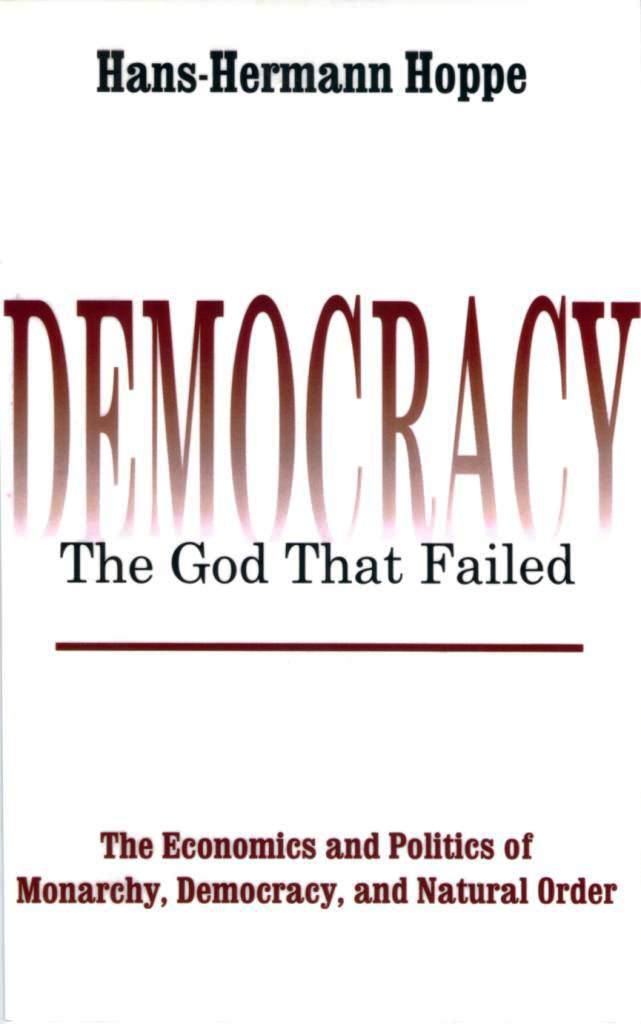
 An Arabic translation of Professor Hoppe’s Democracy: The God That Failed is now available, just published by a publishing house in Kuwait, Takween Publishing, at their press in Lebanon, with an introduction by Nader Kadhum, a professor at Bahrain.
Professor Hoppe’s works are now available in 28 languages in addition to English.
For more on Takween, see Kuwaiti translating English classics into Arabic sees ‘booming’ business.
***
A Short History of Man: Progress and Decline and What Must Be Done have also been published in Arabic: تأريخ قصير للبشر (trans.: Haider Abdul Wahid Rashid).
***
A note was sent to Dr. Hoppe from a friend, describing the publication of the Democracy translation:
Dear Dr. Hoppe:
I’m pleased to inform you that your book has been published in Arabic. I gave a copy of your book to a professor at Bahrain named Nader Kadhum, and then he recommended it to a publishing house in Kuwait, Takween. They decided to publish it. It just came off the press in Lebanon. I believe it will create a stir. Nader wrote the introduction. This now opened a door is, let’s see how well it does in the market, hopefully it sparks more interest. In the Arabic market, when they publish a book, usually they publish 1000 copies. I’ll tell you how well it does when the results are in. I predict it will do very well. Let’s wait and see.
***The book just got printed. There is a big book exhibition in Sharjah, next to Dubai. The opening date is 30th of October, I believe this is the launch date of the book.The publisher told Nader that many people have called and wanted copies of the book. I’m also waiting to hear about people’s response to the book. These ideas haven’t been presented in Arabic before. Many Arabs, especially the more educated ones, believe in democracy.I found it ironic that the book got published while protesters are on the streets. Today I heard that Hariri resigned. If I was the publisher I would start the marketing in Lebanon.***Update after the exhibition:The book has sold out in the stall during the last day of the exhibition. The publisher was a surprised at this. Since their other books are mostly smaller in size and lighter subjects like, literature and some ancient history. They must have sold 300 books in the Bahrain exhibition. A good amount for Bahrain and for the type of book. The next big book exhibition that would spread the book further is Riyadh which takes place in March [2020].My prediction came true. The book did very well, and other publishers were curious what was going on next door. It’s strange for a book that’s theoretical to sell so well. It’s also strange because the publisher, the intellectuals and the readers are all left leaning. I think the endorsement by Nader made the difference. He’s a well respected intellectual in Bahrain. The attention-grabbing title of the book has also played a role.So far I haven’t seen any reviews online in Arabic, they must be reading it right now. They are probably in a state of shock and trying to reassemble their own ideas on political philosophy.I’m very pleased with the result and hope this is the first big success with more successes to come in the future.Also–I found another publisher an Iraqi that published A Short History of Man and right after the speech What Must Be Done.I will update you on any new developments. I think there will be a big response, and from here interest should spread to other countries.***UpdateTomorrow morning, there will be a solar eclipse, and one hour after the eclipse Alayam Cultural Fair (book exhibition) will open and your book Democracy will be released in Bahrain.
The book is eagerly anticipated, because the author that wrote the introduction, Nader Kadhum, is a well known Bahraini writer, historian, and well-respected intellectual. Bahrain is the real launch because of the endorsement of Nader. People are ordering it in the tens, groups already formed to read, discuss and debate it. From here it will spread to the intellectuals, and to the rest of the region, and we’ll get reviews and opinions written about it.
I’ll update you when there are any new developments.

Talk in Hangar-7 – Brexit instead of Brussels: Is the Future of the Nation Belonging?
On October 31, the Brexit is to be completed. Now there is a deal between the EU and the UK. What consequences would Brexit have for Austria? And how justified is the yearning for the nation state?
For the past three years, negotiations have been on Britain’s exit from the EU. Now there is another deal, but does the British Parliament agree? Or it threatens but the hard Brexit, both sides do not want and should not be possible according to British law. What could an agreement look like? Will Brexit continue to strengthen nationalist forces across Europe? And why is the EU increasingly losing its appeal?
It is not just since the British exit referendum in June 2016 that many European citizens are yearning for a strong and sovereign nation state. What is behind this wish? Why is the EU evidently moving away from its citizens? What makes Europe today and does the EU really bring us more advantages than disadvantages?
Guests:
Karoline Edtstadler, ÖVP delegation leader in Brussels
Leigh Turner, British ambassador to Austria
Hans-Hermann Hoppe, economist and anarcho-capitalist
Aleksandra Rybinska, Polish publicist
Stefan Junker, psychologist and author
Moderation: Michael Fleischhacker
[Update: Link below is bad; alternative link here: https://bittubers.com/post/6043bbbb-0901-401d-9c90-ffeb2bf90a8c]
https://www.servus.com/tv/videos/aa-1zs84272n2112/
This is professor Hoppe’s speech for SVTV (SVETOV TV) on Oct. 6, 2019, in Moscow.
From the shownotes:
On the 6th of October 2019 some 1500 Russians came to listen to Libertarian thinker Hans-Hermann Hoppe in Moscow. It was the biggest libertarian event in the history of Russia and the biggest libertarian lecture in Europe. Foreword and afterword by Mikhail Svetov [Михаил Светов].
The event was “Hans Hermann Hoppe: So To Speak”, and the title of Professor Hoppe’s speech was: “Historical Patterns and Tendencies in Austro-Libertarian Perspective” — in which he tells three related stories or narratives that explain the present world.
First: regarding the origin of states and the changes of state constitutions over time: a historical reconstruction.
Second: regarding the concentration of states, issues of war and imperialism.
Third: regarding money and banking and monetary centralization.
Transcript below.
Unedited Transcript from Youtube
Greeting to Moscow! Greetings to the future free people!
Unbelievable! When I was planning this event, I couldn’t imagine that 1500 people will show up to a philosophy lecture.
It’s unprecedented not only for Russia, but for the world.
when I’m told that Russians aren’t ready for freedom, I laugh.
Clearly it’s not true. Russians are born ready for freedom.
When I started my youtube channel, I had a dream to talk with people whom I admire and looked up to.
People who helped me grow intellectually and those who have disappointed me.
People who played a role in my growing up. And it makes me happy to be able to have conversations
not only with Russians, but also with those from overseas. And today, I flew Dr. Hoppe to Moscow.
He is one of the greatest libertarian philosophers of our time. The author of the acclaimed book “Democracy: The God That Failed”.
The disciple of the Murray Rothbard, who is the father of the libertarianism as we know it today.
When I give my own lectures across Russia, I stand on the shoulders of giants.
And I’m proud to say that I got to know one of those giants personally. The one, who influenced me so much.
And today he will give a speech on this stage. One of Dr. Hoppe’s greatest achievements is that
he popularised libertarianism as a political doctrine,
a legal doctrine He proved that it doesn’t matter what cultural values you uphold,
as long as you agree to a non aggression principle
you are a libertarian. When Dr. Hoppe said it out loud, when he started to defend conservatives from left wing libertarians,
he was slandered by the big and powerful.
If you are interested in the history of Cato Institute and Mises Institute, you can read about how big money
corrupted libertarianism, libertarian movement in the West.
How it became possible with the help of the very rich people. The same thing happened with liberalism in Russia a while ago.
One of the reasons I wanted to organise this event for so long, and the reason I’m so happy that so many of you have showed up today is that
I want to help people understand that libertarians don’t protect rich from the poor, conservatives from liberals or vice versa.
We want to protect everyone who’s ready to live by the non aggression principle from everyone who’s not. Libertarians divide people by the means they use to reach their goals, not by the goals themselves.
It doesn’t matter to us what goals you may have. We care about what means you choose to achieve those goals.
In that sense no values are “toxic”. There’s no such thing as “toxic views”.
There’re views that some of us may prefer to condemn, but as long as they are practised non-aggressively they are neither better nor worse than anybody else’s.
In a minute Hans Hermann Hoppe will take this stage and explain how democracy erodes civil liberties.
And why the decentralisation of power is the key to protect a person’s freedom.
He will explain how there can be no freedom of association without the freedom not to associate.
And how private borders can set a person free.
Because a world without borders is a world with nowhere to run. Thank you very much! Please welcome Hans Hermann Hoppe!
Thank you all very much. I’d like to add a couple of words.
I want to tell you why Philosophy matters and why it’s important to study it.
Why is there a Libertarian theory? What is the purpose behind our principles?
Hans Hermann Hoppe just told you about the goals the Libertarians have. He explained that decentralisation is the key.
There’s no right version of how the society should look like. What matters is to be free to choose the society you want to live in.
What sets a man free is a freedom of choice. It’s impossible to come up with a universal ideal.
It’s impossible to come up with a universal ideal that will set everyone free. That’s what Liberals got wrong.
That’s why liberal experiment is failing in Europe, in the West.
Again, freedom of choice is what liberates a man. And that’s what the libertarians want to protect – your freedom of choice.
So, why do we need Philosophy? When Libertarians advocate for decentralisation, autonomy, absolute freedom,
society with no government, we are not saying that government should fall by tomorrow.
We are not saying that all these ideas – those ideals – can be achieved straight away.
We are not saying that that’s how you can make Russia a free country.
Our ideology – Anarcho-Capitalism – is our guiding star.
It’s our compass. It shows us the right direction. It tells us: “Freedom is that way”.
The compass shows you the right direction no matter what the surroundings are.
However, if you will only look at the compass ignoring what’s on your way, you’ll be soon run over by a car or fall out of the window.
Because ideas by itself are not enough to change the world. You have to take the power consensus into account and work towards changing that consensus.
That’s where real politics start. When we practice libertarian philosophy politically it’s called Minarchism, a night-watchman state.
Minarchism is what happens when we start to acknowledge the circumstances we’re in.
When we acknowledge the rules that living in a society sets.
If we ignore those things, we will never be able to guide people towards a freer world, towards decentralisation.
So, Anarcho-Capitalism and Minarchism are two sides of the same coin. Anarcho-Capitalism is our ideology.
Minarchism is how we apply it to the real world. You combine these two things and you get Libertarianism.
Anarcho-Capitalism is not something you can ever achieve. Perfection doesn’t exist in real world.
Anarcho-Capitalistic theory is there to give us answers, to show us the direction of freedom.
But, despite the fact that we can’t make dreams a reality, we can neveretheless move only in the direction of freedom.
One of the most important things I took away from Dr. Hoppe’s book
is that we have to fight against power, not for the power.
We should fight against the concentration of power that turned Russia into a prison of nations hundreds of years ago.
It’s not just a cute phrase, it has a strong meaning behind it.
When we say that Russia is a prison of nations, we mean that the concentration of power has led to the situation
where the politicians are now making laws to benefit them and not the people. People in charge are not accountable to the society.
But even if they were… Let’s imagine that a saint man is now in charge.
A person who’s willing to sacrifice his own interests and desires in order to make Russia a better place.
Will he succeed? Of course, not. Because in a place with so much centralised power
you can’t make laws that will make everyone happy, even if you try.
There is no such law that can equally benefit people from Moscow, Kaliningrad, Chechnya, Ingushetia, Bashkiria, Yakutia.
Because we have different needs and goals. And now we’re in a situation where laws are equally harmful to all people living in Russia.
Today we are fighting for our future. We are fighting to take the power away from our enemies.
We are fighting for the Iron Throne. In the past, I used an example of the one ring from “The Lord of the Rings”. That’s what power is.
But I think, all of you’ve watched Game of Thrones too. It’s impossible to win the war by taking over the Iron Throne.
You can only win the war by destroying the Iron Throne. Thats what libertarians are fighting against.
We want the centralised power to go. Unlike leftist dreams, this dream more than possible to achieve within the borders of a single country.
Russia is so big and mighty, and to protect its greatness and our freedoms
we have to fight for our freedom to make choices for ourselves.
To be free of the Iron Throne. Laws shouldn’t be made in Kremlin.
It may be hard to explain to Moscow citizens… I just came back from my tour across the country, where people really get what I have to say.
Maybe, if you forget for a minute that you live under Kremlin’s walls, you will get what I’m saying too.
Today, laws are only made to benefit people in power. Today, it’s impossible to make them any other way.
In Moscow we at least have political institution to which we can go protest.
Other Russians are not that lucky. Today, Dr. Hoppe talked about privileges a lot.
The government is a propagator of those privileges. It’s the exact reason we have social stratification.
Only with the help of the governmental coercion can you make a privileged group of people.
It happened in Czarist Russia, it happened in Soviet Uniot and and it’s happening today.
When you dream about The Great Russia of the Future,
when you try to come up with the ways to help Russia and Russian people, you should realise that the big centralised government is the greatest threat to that dream.
I already mention that Russia today remains a prison of nations.
And the right-wingers have one fair point – that Russia is an anti-Russian state.
It’s true, nationalists got that right. Russia is an anti-Russian state.
It’s also an anti-Bashkir state, anti-Chechen state, anti-Yakut state.
Because it doesn’t benefit any of the nations living our great country.
The right-wingers have another fair point.
When USSR fell apart, Yeltsin came up with a horrible phrase “People of Russia”.
So, what does “People of Russia” mean? It’s a homunculus of a soviet man.
When the soviet experiment failed horribly, what was left of a soviet man is a homunculus.
But that phrase used not only to erase Russian identity. It’s used to erase every single identity in Russia.
And until we realise that we should fight the oppressive government instead of fighting each other,
we all end up grinded into People of Russia. Again, we have to fight against the source of power, not for the power.
We have to fight for our country, for our people. We must hate those who try to destroy our country. Resist them.
If we don’t resist, we will perish from this world, as did other great nations.
Remember there was the great Roman culture? Great language, art.
They had Gods they prayed to, traditions they wanted to pass on to future generations.
So, what happened to them? They turned into a footnote in a History book.
Now Barbarians live there. There was Egypt. Great culture, great language.
They gave us Geometry. Who lives there now?
The Arabs, that’s right. So, what happened to the Egyptians? They turned into a footnote in a History book.
There was Babylon. They, too, had their Gods. They had culture they cherished.
What happened to the Babylonians? They too turned into a footnote in a History book. So who passed through millennia?
Who preserved their values, their Gods, their culture?
Who have successfully preserved their identity up until today, and why?
It was the Jews.
So, why did they succeed? They were persecuted everywhere all the time. In Egypt, in Babylon, in Rome.
However, they never confused the survival of their nation with survival of the state. That’s why they were never buried under the rubble of fallen empires.
So, if you cherish your traditions, your language, your country, your culture,
you have no right to entrust the state with these things. Otherwise, all of it will be destroyed.
Become a Libertarian! Thank you very much for your attention!
From PFS 2019:
Hülsmann, Kinsella, Dürr, Hoppe, Q&A (PFS 2019)
***
From the recently-concluded Fourteenth Annual Meeting of the PFS, Bodrum, Turkey (Sept. 12–17, 2019).
For others, see the links in the Program, or the PFS YouTube channel, including the growing PFS 2019 YouTube Playlist.
Additional information about the 2020 Annual Meeting (scheduled for Sept. 10–15, 2020) will be released presently.
From PFS 2019:
Hans-Hermann Hoppe, The Failure of ‘Ontological Naturalism’ (PFS 2019)
From the recently-concluded Fourteenth Annual Meeting of the PFS, Bodrum, Turkey (Sept. 12–17, 2019).
For others, see the links in the Program, or the PFS YouTube channel, including the growing PFS 2019 YouTube Playlist. Additional media of the proceedings will be released presently.
Additional information about the 2020 Annual Meeting (scheduled for Sept. 10–15, 2020) will be released presently.
 A Chinese (Mandarin) translation of Professor Hoppe’s The Ethics and Economics of Private Property has officially passed Chinese censorship review and will be published soon in mainland China.
 Uma Breve História do Homem: Progresso e Declínio, a Brazilian Português translation of A Short History of Man: Progress and Decline (Mises 2015), is now available on Amazon Brazil.
According to Matheus Vieira, who alerted me to this, the first run (about 5 thousand copies) sold out already in about 9 months and is already on the second run—very impressive given the subject matter and type of book. Vieira also informs me that the publisher is working on a translation of The Economics and Ethics of Private Property.
A slew of Hungarian translations of Professor Hoppe’s works has just come to our attention, and are all listed here:

As noted here, at the 2019 Austrian Economics Research Conference in Auburn at the Mises Institute, Professor Hoppe was honored a panel presentation “The Significance of Hans-Hermann Hoppe,” on the occasion of Professor Hoppe’s 70th birth year.
Lew Rockwell’s recent review of Professor Hoppe’s Getting Libertarianism Right is here and repixeled below:
***
Part I of The Libertarian Quest for a Grand Historical Narrative, Mises Wire (Nov. 5 2018), has been translated into Portuguese, as A busca libertária por uma narrativa histórica global (March 13, 2019).
Hoppe on Austrian TV (SERVUS TV) on Brexit and the EU. (SERVUS TV is a private TV-station, and part of the Quo Vadis Veritas Foundation established by Dietrich Mateschitz, co-founder and majority owner of Red Bull) Published on Jan 23, 2019.
The other discussants:
- Irmgard Griss, member of the Austrian parliament for the NEOS (LEFT-liberals), and former head of the Austrian Supreme Court
- Leigh Turner, British Ambassador to Austria
- Marcus Pretzell, member of the European Parliament (elected on the list of the AfD – Alternative für Deutschland – who left the party immediately after his election to join a new, somewhat more PC splinter group, the Blues)
- Thomas Brezina, Austrian living in London, internationally bestselling author of children’s books
Update: English subtitles for selected excerpts are available below (from HANS-HERMANN HOPPE ON BREXIT):