Note: Due to Twitter currently blocking links from HansHoppe.com, it is mirrored at Mises Institute: Quo Vadis?
Mises Institute: Quo Vadis?
Hans-Hermann Hoppe
March 25, 2026
My close, personal association with the Mises Institute goes back more than 40 years, to 1985, only three years after the Institute’s founding. In the course of the years I have given dozens upon dozens of lectures. I have been awarded its Schlarbaum Prize and the Rothbard Medal. For a decade, I served as editor of its Journal of Libertarian Studies. I am the MI’s only long standing Distinguished Senior Fellow. Only two years ago, in 2024, I was a featured speaker at the Institute’s Human Action Conference, and my 75th birthday was celebrated at the occasion. In the same year I sent this congratulatory note to Lew Rockwell at the occasion of the festivities organized in honor of his own 80th birthday:
Dear Lew, to your 80th birthday I send you my best wishes and want to say thanks for by now almost 40 years of friendship and intellectual camaraderie.
I know you are too humble to say this, but I can certainly do it: You rank among the most brilliant commentators and analysts of the present age and you are the world’s greatest living promoter of sound economics in the tradition of Ludwig von Mises and Murray N. Rothbard and, more generally, of liberty, peace, common sense, and reason.
Your legacy is assured: You are already a legend.
Yours truly,
Hans
And Lew immediately replied:
Wow. Dear Hans, God bless you for your extraordinary letter, which was the high point of the event, and did me great honor. Now all I need to do is try to live up to it!
Only one year ago, again, in 2025, I was invited to give the Ludwig von Mises Memorial Lecture at the Austrian Scholars Conference, and a special dinner was set up in my honor. 1 Everything appeared to be fine and harmonious.
Except: It was heart-wrenching to see the deterioration of Lew’s health, owing to the shocking deterioration of his health. He had difficulties speaking and he could no longer type. It was apparent that he could not possibly anymore be in full control of the mighty intellectual enterprise—the MI and LRC—that he had built up in some forty years. I also had some beginning doubts that he was the actual author of everything still written and published under his name. However, in the course of our dinner, and cautiously touching on the question of ‘the future’ of his enterprise, he assured me that everything had been taken care of and was in good hands. Just a year ago, Tom DiLorenzo, Emeritus Professor of Economics at Loyola University, Baltimore, long-time friend and Senior Faculty member of the MI, prolific writer of numerous nationally acclaimed books and accomplished public speaker, had been hired as the MI’s new president. As well, long-time associate and personal friend Karen De Coster, who had spent a lifetime in executive positions in the corporate world had been installed as Chief Financial and Operating Officer.
*
Upon my return to Europe, then, I felt relieved. Yet only a few months later, in the late summer of 2025, I was informed by Professor Guido Hülsmann, Mises biographer and MI Senior Fellow, that he had just learned that Tom DiLorenzo and Karen De Coster had been put on “administrative leave” and by all appearances were about to be fired, owing to disagreements between them and other staff members regarding the current and future management of the Institute.
While both of us were not involved in the daily business of the Institute nor in any discussions about vision and strategy, whether on the Board level or among the Institute’s employees, and neither of us were on the Institute’s payroll, as long-standing and close associates of the Institute we felt that it was our duty to weigh in on the matter at hand and express our concerns. To this effect, we wrote a joint Memorandum addressed to Lew and the members of the Board (appended below; pdf).
Therein, we first reminded the Board that the exact same or somewhat similar problem had already led to the departure of the previous President, Jeff Deist, a mere three years ago, and we then tried to draw the Board’s attention to what we considered the root cause of the present problem: an inappropriate set-up of responsibilities owing to a structural flaw in the organization of the Institute.
In any functioning organization, the standard solution to avoid internal conflicts or frictions is that the President prevails and that all subordinate officers comply with his orders. The President, once elected, must have the authority to decide on all matters. He may choose to delegate some of his powers, but in principle his decision must be final. And the Board of the organization has the duty to back the President and relieve him of his duties only in case of manifest malfeasance, fraud or treachery—but not because of some mere “difference of vision or opinion” between him and other staff or on account of someone’s “dissatisfaction,” “unhappiness” or “complaint.”
But this has not been the set-up of the MI. Instead of a unity of leadership, the MI had institutionalized a duality of leadership that was inevitably bound to result in irresolvable conflict. One the one hand, there was the President (Tom DiLorenzo) and on the other hand there was the Vice-President of Academic Affairs (Joe Salerno). Normally, this would have made DiLorenzo Salerno’s superior. But while DiLorenzo, qua President, was to attend Board meetings he was not also a Board member, all the while Salerno had been appointed as a permanent Board member and as such was de facto, materially, the hierarchical superior of any President, whoever that might be. Salerno, qua permanent Board member, was placed in a position that allowed him to defy, challenge and overcome virtually any sitting President. And this state of affairs did not only impact his own relationship with the President. It could not fail to also undermine the relationship between the President and all other MI employees. Indeed, a President who cannot prevail on his senior executives was bound sooner or later to lose the respect of the other employees. Eventually, intrigue, rebellion and mutiny would become acceptable reactions in response to his orders.
We indicated in our Memorandum how to repair the structural flaw that we had identified and offered our further advice. But to no avail. There was no reaction whatsoever in response to our Memo, from any side. No word, in particular also not from Lew Rockwell, the Chairman of the Board, lending additional support to my/our growing suspicion that he had lost control of the Institute.
The end of the “DiLorenzo affair,” then, came rather quickly. As predicted in our Memo, it was some internal cabal that led to the dismissal of DiLorenzo and De Coster as President and CFO. Salerno had prevailed over both the President and the CFO. There was no explanation given for this decision (and DiLorenzo and De Coster were bound by Non Disclosure Agreements). A letter was sent out to the donors, signed by Lew, simply stating, deceivingly and untruthfully, that both had resigned from their positions, rather than having actually been fired. (Revealingly, although Gülçin, my wife, and I had been significant donors, too, we did not receive this very letter, presumably because we knew the actual truth.) As well, it was announced in the letter that a search for a new President was immediately to begin.
(Incidentally, the previous Deist era had ended somewhat differently, but for essentially similar reasons: Deist had tried to “professionalize” the MI’s and especially the Board’s organization and thereby encountered Salerno’s destructionist opposition, backed up by Lew. Thereupon, in deep frustration, and along with several prominent former Board members (Judge Andrew Napolitano was forced out), he resigned from his position as President.)
Given the recent experiences of first Deist and then DiLorenzo and given the present institutional set-up of the Institute, Hülsmann and I had predicted in our Memo that this search would not be an easy task. For who, what person of any significant standing and stature would want to take on such a risky job?! And indeed until today, some eight months later, no new President has been found. Instead, most likely at Salerno’s urging, an increasingly and visibly weakened Lew was persuaded to install two long-time subaltern employees as interim executive directors, who Salerno then, qua undisputed academic head, could easily manipulate (more on this later).
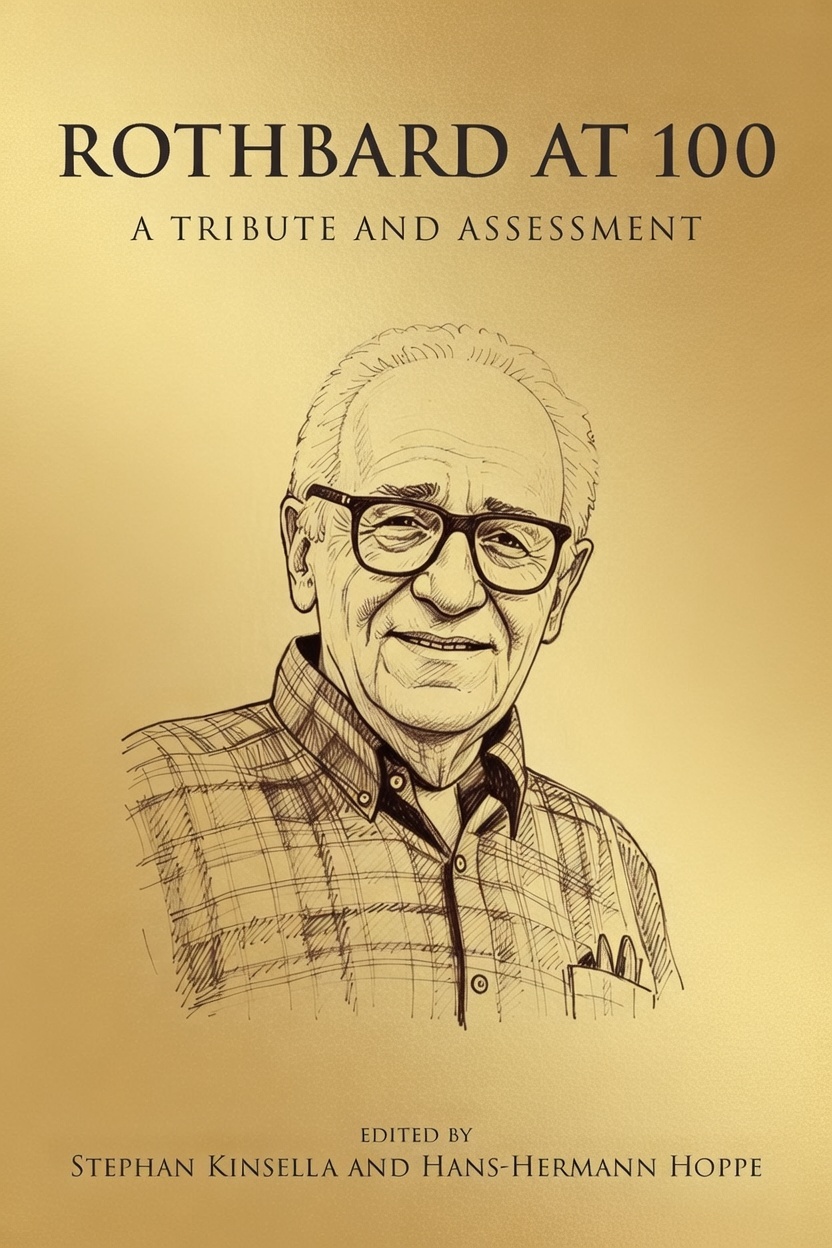
I was left disillusioned. Apparently shut out, but aware of Murray Rothbard’s upcoming 100th birthday on March 2nd, 2026, I decided to embark on an independent enterprise. Together with Stephan Kinsella, long-time friend and leading Austro-Libertarian legal theorist, we decided to produce a Gedenkschrift in Rothbard’s honor for the occasion, to be published under the auspices of the Property and Freedom Society, the annual intellectual salon I had founded twenty years before, in 2006. And indeed, precisely on March 2nd the Gedenkschrift, edited by Kinsella and myself, was released. 2
Incidentally, on the same day, the Mises Institute, with a staff of some 30 people and backed by a huge, multi-million dollar endowment, accomplished no more than to send out a fund-raising letter, allegedly written (in any case auto-signed) by Lew, begging for more money in order to help celebrate the “Year of Rothbard.”
On March 2nd, our Gedenkschrift was sent also to Lew Rockwell, expecting a word of congratulation, as one well could and should. But there was no response. On the next day, I sent him this follow-up letter:
Dear Lew,
Until recently, whenever I would send you an email you would almost immediately respond. Nowadays, after the ouster of DiLorenzo, there is nothing but silence. You either ignore me or someone else screens my mails and prevents you from seeing them. Why? What is your beef with me?
Yesterday I sent you the book that Kinsella and I wrote and compiled to celebrate Murray’s 100th birthday. There was not even an acknowledgement from you, all the while the MI did no more at the occasion than ask for donations to celebrate Murray, without actually having anything to show for. No celebratory article, nothing.
I know that you agree with my assessment of Milei. You told me so. Normally, then, you would have published my introduction to the book I sent to you. But no, nothing this time. Because the new MI leadership invited Huerta de Soto, the leading Milei propagandist, to speak in Auburn in a couple of weeks and they want to suck up to him?
What have I done to deserve this treatment? I have been a main attraction for the MI and Gülçin and I have been significant donors. Why?
Best
Hans
Again: no response. So I sent another letter:
Dear Lew,
since I still have not heard back from you and I still cannot believe that there is ill will at play—after all when we last met, in March of 2025, you repeatedly emphasized how important I had been and still was to the MI—I can only assume that the suspicion indicated in my letter of yesterday is indeed true and, owing to your deteriorating health, control has been wrested away from you and other people now read and handle your mail.
Shameful.
Two people, Kinsella and I, a shoestring operation if you will, wrote, compiled and published a book on March 2, to celebrate Murray’s 100th birthday. To this day, the Mises Institute did not even acknowledge this feat.
With a staff of almost 30 people and rolling in donors’ money, all the MI accomplished at the occasion was a letter begging for more money, and now, a couple of days later, republish the Festschrift in honor of Rothbard from 38 years ago!
How to explain this conduct? Pettiness, envy, jealousy? In any case, this is not how honorable people behave.
Hans
Finally, my suspicion that someone else read and screened my emails to Lew was confirmed. Not by the person I believed and still believe to actually do so but instead by Lew’s wife Mardi, writing:
Dear Hans,
Just a quick note to let you know Lew has been ill for the past few months. I read him your email and he will answer as soon as he is better. He doesn’t read his email some days. He values your friendship and all you have done for the Institute over the years. Please pray for him. All the best to you and your family.
Love,
Mardi
More than two weeks later, there has still been no word forthcoming from Lew, no explanation, no nothing. But interestingly there have been still fund-raising letters sent out supposedly written and signed by Lew and there have been still articles published on LRC under his name. Obviously someone here was lying and deceiving, and it was most certainly not Mardi.
Next, to dig deeper into this apparent pool of corruption I turned to Ryan McMaken, Editor in Chief of the MI website. Notwithstanding the fact that the MI had announced 2026 as the “Year of Rothbard,” there had been and still, to this day, has been no mention or acknowledgement of our book by the Institute (only a tweet over two weeks later by Mises Institute scholar Wanjiru Njoya). I offered McMaken my above linked introduction for publication at the Mises Wire, and this is what happened: First nothing. Then I followed up with this email:
Ryan,
Several days ago I submitted the following article to be published at Mises wire. As you know, I am the only long standing Distinguished Senior Fellow at the MI and I am generally recognized as Murray Rothbard’s most prominent student and intellectual heir. Still, I have not heard anything back from you.
I (and not just I) are curious to know: Is it your decision to ignore me and show no willingness to publish my article or are you under orders not to do so?
HHH
McMaken came first back with this:
Thanks for the follow up. I see your earlier email went to the spam folder. I’ll have a look at your submission today.
Strange enough that the mail of a Distinguished Senior Fellow should land in the spam folder, but hardly surprising anymore then was McMaken’s following quick decision:
Good Afternoon:
Thank you for submission, but we are going to pass on this one. The primary reason is that it so heavily focuses on Rothbard’s work as a libertarian movement strategist, and movement issues in general, with very little about Rothbard’s work as an economist. Mises.org has generally steered clear of movement content, allowing LRC (as with the old RRR) to be more the publication that covers political coalition building or issues with the libertarian movement. We have been working to better draw this distinction between movement/strategy publications and mises.org.
Regards,
Ryan McMaken
In response I only briefly remarked:
I am sure that is also the reason why the MI does not even recognize the entire book that we published in honor of Rothbard on March 2, while the MI with a staff of about 30 did not accomplish more than to send out a fund raising letter on that day.
I take your response as confirmation that you act under orders.
HHH
It should be noted that McMaken’s reason given for the rejection of my article was a bald-faced lie. Dozens upon dozens of articles published on the MI site were not restricted to the discussion of purely economic matters. Practically none of the articles written by David Gordon or Wanjiru Njoya were, for instance (not to speak about the various pieces by some Connor O’Keefe). More importantly, the very man: Murray Rothbard, was most emphatically not a narrow minded economist-economist, but an interdisciplinary scholar interested in and familiar with the widest range of subjects. The excuse given for the rejection, then, is just silly, most likely fabricated under orders from higher up.
Thus, to gain ultimate clarity in the matter I finally turned to Salerno, the new big boss. I sent him the above correspondence with McMaken und asked him directly if his rejection letter had found his approval. This, then, is the correspondence that ensued:
Salerno:
Dear Hans,
As I have indicated to you on previous occasions when you have emailed me about articles that were published or were submitted and not published on Mises.org, Ryan McMaken, the Editor in Chief, has the final authority to accept or reject submissions to the website. I advise him on the soundness of technical economic articles when he requests me to do so but even in those cases the final decision to accept, reject, or request revisions is his and his alone. Indeed, I never see submissions to the website in advance of their publication on Mises.org unless Ryan requests my advice. I might add that I have never had a reason to question Ryan’s editorial decisions.
You should also know that neither Ryan nor I are ultimately responsible for the positions and content expressed by the Mises Institute. That responsibility falls to Judy Thommesen and Chad Parish. They are the Executive Directors of the Mises Institute, chosen by the Board of Directors and Lew to lead the organization. They have been working directly with Lew, and with his and the Board’s approval. Judy and Chad have been entrusted with full power and authority to take any actions and make all decisions they deem to be in the best interests of the Mises Institute.
Best regards,
Joe
Hoppe:
Dear Joe,
thanks for clarifying matters. It is truly reassuring to know that the over-all operation and over-sight of the MI, and in particular the task of honoring and preserving Murray Rothbard’s legacy, is placed now safely in the hands of Chad Parish and Judy Thommesen, who are both completely unknown outside the walls of the MI and whose contributions to the Austro-Libertarian edifice are apparently a total and well-kept secret.
Best
Hans
Salerno:
Dear Hans,
Judy and Chad thoroughly understand the mission, organization, and operations of the Mises Institute and it was Lew’s idea to suggest them to the Board for the positions they occupy. I am fully confident that they will keep the ship on course. In the meantime we are searching for a president to serve as the face of the Institute.
Best regards,
Joe
Indeed, now I can see everything quite clearly: an astonishing picture of obfuscation, deception and lies.
For one, given my standing in the MI as a Distinguished Senior Fellow it is very unlikely, while not inconceivable, that McMaken would not have asked Salerno for his advice in the matter. But in any case, it is remarkable how Salerno obfuscates his answer to my direct question. He could have said (but didn’t), for instance, that if he had been consulted he would have decided differently. However, he claimed instead that he had nothing whatsoever to do with the entire matter, only to add that he had never had any reason to question McMaken’s editorial decisions, which obviously implies that he also had no problem with McMaken’s rejection of my article and in fact approved of his decision. Why? My guess: Salerno feared that with the publication of my article and any publicity given to the Rothbard Gedenkschrift, produced by two “outsiders,” he and “his” Institute would have been publicly up-staged.
Even more revealing and deceiving is what comes to light in his responses concerning the internal structure and operation of the Institute. Salerno, qua Academic Director, admitted that he essentially lets his Editor in Chief do whatever he wants. Yet isn’t this a dereliction of duty? Isn’t it an academic director’s duty to regularly look at what his subordinate editor is doing? Of course, however, if you don’t ever look at what someone is doing, it is only logical that you can also never discover any fault of his (as Salerno claims to be the case with McMaken). It is far from me to deny that many excellent articles have been published under McMaken’s direction at the MI, but I have also encountered quite a few pieces that would have to be classified as sub-par, dilettantish, faulty or plain wrong.
The likely cause of this apparent deficiency: All three previous MI presidents, Doug French, Jeff Deist and Tom DiLorenzo, all of whom contributed to the Rothbard Gedenkschrift, have unanimously described Salerno as lazy and unproductive, an attitude that naturally affects and spreads also among the entire institute staff.
Which brings up the most shameful lie: regarding the appointment of the two mentioned executive directors, “entrusted with full power and authority to take any actions and make all decisions they deem to be in the best interests of the Mises Institute,” and “working directly with Lew, and with his and the Board’s approval.”
There may have been legal requirements to appoint some “executive director(s)” after DiLorenzo’s ouster, but anyone who knows anything about the MI also knows that this has had no effect whatsoever on the actual power structure of the Institute. Qua executive directors, Chad Parish and Judy Thommesen may have received a pay-raise, Chad was able to fire the controller previously hired by De Coster and Judy was apparently enabled to add her husband onto the Institute’s payroll. As a matter of fact, however, neither Parish nor Thommesen can make any significant decision regarding the Institute without Salerno’s approval. To put it most bluntly: they could never ever fire Salerno, for instance, while Salerno could get rid of them almost instantly, if he so wanted. Regardless of their new titles, both executive directors are and remain Salerno’s subordinates and take their orders from him, just as before.
And as for the directors’ alleged close cooperation with and supervision by the Board: It only needs to be recalled that the Chairman of the Board, Lew Rockwell, as confirmed by Mardi, his wife, is and has for quite a while been essentially out of commission. Severely weakened by his deteriorating health, it has been an easy task to sweet-talk him into making the “right” decision, and given his condition it is completely out of the question that he could exercise any active supervision of any of the Institute’s ongoings.
As for the rest of the Board: it should be first noted that the real board consists of an “inner” board of five permanent or “Subscriber” members; these are the board members exercising true control of the organization. Next to Lew, the “inner” board includes, most problematically, Joe Salerno (a paid employee); Peter Klein, Professor at Baylor University, but also on the MI payroll as so-called Senior Academic Advisor and Salerno’s sidekick; and then there is Lew’s sister and his sister-in-law (whose son and daughter-in law are Institute employees).
The other board members appear to have no real power and are mostly window dressing, since the inner board members can exercise an ultimate veto in that they can remove any other non-subscriber board member (as we saw with Judge Napolitano); the outside board members include Ron Paul, age 90, John Denson, age 90, Don Printz, age 85, and three low-profile donor-businessmen, Steve Torello, Mark Murrah and Yousif Almoayyed.
It is a joke to claim that this inner Board could or would exercise any serious control of the inner workings of the Institute’s new executive directors given that over half of that group are paid employees of the organization or have close ties to such employees. Even if there is no self-dealing the very structure invites that temptation while appearing suspicious to any outside observer. That this structure is obfuscated by a surrounding layer of “outer” board members is telling.
In any case, however, it was not the two newly appointed executive directors who took the MI off course. They did not invite Jesús Huerta de Soto to present the recent, 2026 Mises Memorial Lecture. It was Salerno himself, who did so and thereby betrayed the legacy of Murray Rothbard and Lew Rockwell (who was actually no longer able to even attend the very lecture).
To be sure, JHS had made some outstanding contributions to monetary theory, and he was a highly respected member of the Austrian School of Economics. His interest in anarcho-capitalism, the central topic of his lecture, was more recent, and there was not much if anything new or original to be heard in this regard. In any case, however, his invitation would have been highly deserved.
But: During the last few years, beginning sometime around 2023, JHS had become the enthusiastic member of what may be called a mutual admiration society, essentially made up, besides himself, of the Argentinian President Javier Milei and Philipp Bagus, JHS’s German sidekick. They showered each other with invitations, prizes, awards and money, whether in Spain, Germany or Argentina and thereby greatly enhanced their own prominence. Yet here is the rub: While JHS (and Bagus) hailed Milei as the great new shining star on the libertarian scene and the long-awaited Messiah of anarcho-capitalism, Milei, who claimed Rothbard as his main source of inspiration, actually turned out to be a highly dubious character, a fake libertarian, crook and warmonger. For proof of this I only refer back to my above mentioned introduction to Kinsella’s and my Gedenkschrift in honor of Murray Rothbard. 3 See further on this subject also this, 4 and this 5 in particular on Rothbard’s view regarding the peace-and-war question as the key issue to all of libertarianism.
Notwithstanding all this damning evidence, however, JHS, during the last five minutes or so of his speech, as was to be expected, could not abstain from reciting again his by now standard praises of Milei. Revealingly, his praises only included Milei’s rhetorical performances, his high-sounding libertarian copy-and-paste speeches delivered in typical Latino-style, however. Yet there was not a single word to be heard from JHS about all of Milei’s broken promises, his multitude of anti-libertarian measures, his loud and proud profession as the world’s greatest Zionist president, as the enthusiastic supporter of his “great friend” Netanyahu’s monstrous genocidal war in Gaza, an obviously deranged Donald Trump, and of the USrael war of aggression against Iran.
Murray Rothbard would have strictly opposed an invitation to JHS on this ground and for this reason and so would have the former, still vigorous and healthy Lew Rockwell. Likewise, and for the very same reason, Tom DiLorenzo would not have invited him.
That Joe Salerno, who very well knew what Murray thought about the Neo-cons, about Zionism and Israel and who also knew quite well about the actual Milei and about JHS’s close association with him, did so nonetheless, came as a shock and represents no less than an open betrayal of Rothbard’s and Rockwell’s legacy. Why? I have no clear answer and must speculate. Was Salerno himself a secret Mileiist, although he had always strictly denied this in earlier conversations that we had on the topic? Or did he intend to use JHS to gain direct access to Milei and replicate what the German Mises Institute had done already before: to sell out, forget about fundamental principles, and invite Milei to Auburn to receive some prize so as to gain more popularity and attract some previously inaccessible donor class? Is the MI to become the next example of what its former president Doug French has described in a recent book published under the auspices of the Property and Freedom Society: 6 a movement turned into a racket? In any case, there are ominous signs on the horizon.
Finally: Why am I writing all this? I am not under the illusion that any of this will have any noticeable effect on the MI and its operations. The MI sits on an endowment of more than $70M. Nonprofits almost never implode, and with this endowment the Institute can limp along for decades, almost regardless of what it does or doesn’t do. There is always a clueless generation of older donors leaving some big estate gifts behind, and there is always another generation of new donors coming along, attracted by a good show and some freebies.
My sole purpose in writing this, then, is to let the truth be known, and to thus honor and protect the intellectual legacy of my dear friend and mentor Murray N. Rothbard.
Istanbul, March 2026
HHH
***
Appendix
Memo to Mises Institute Board
By: Hans-Hermann Hoppe and Jörg Guido Hülsmann
Date: August 20th, 2025
(pdf)
Dear Lew,
Dear Board members,
Dear friends,
Last week we have learned that Tom DiLorenzo and Karen De Coster have been put on “administrative leave” and, by all appearances, are about to be fired, even though they are currently still listed on the faculty page (https://mises.org/faculty-staff). We have also learned that the fundamental reason for their “leave” are disagreements between them and other staff members about the current and future management of the Institute.
We write to you to share our assessment of the situation, along with a call for you to act without delay.
Since we are not involved in the daily business of the Institute nor in any discussions about vision and strategy, whether on the Board level or among the Institute’s employees, we do not wish to weigh in on the current disputes one way or another. However, we should like to remind you that the exact same problem (disagreement between the President and other employees) has already led to the departure of the previous President a mere three years ago. In our eyes, and this is the main point to which we should like to draw your attention: the root cause of the problem is an inappropriate set-up of responsibilities.
This problem can be best illustrated in considering the role of Joe Salerno. For many good reasons, he is a key person at the Institute, not least for his competence and undisputed loyalty to our cause. Of all people, he is closest to the Institute’s founder and chairman, Lew Rockwell. So special is Joe’s standing that he is both an employee (Academic Vice-President of the Institute), in which capacity he is subordinate to the Institute’s President, and at the same time a permanent Board member. Inevitably, this brings about an awkward state of affairs. Even though Joe is formally an employee of the Institute, in fact, materially, he is the Vice-Chairman and therefore the hierarchical superior of the President.
This not only entails a conflict of interest for Joe, whenever the Board has to deal with matters that affect his own compensation or his operational responsibilities. It also brings about conflicts between him and any President, no matter who that President may be.
When Lew Rockwell was leading the Institute such conflicts did not materialise, because Lew fully trusted the lead academic (Murray Rothbard until 1995, then various other people) and never bothered to get involved in any academic issues. However, it should be emphasized that, being the President, Lew could have weighed in on academic issues. As the Institute’s founder, he had the moral and juridical standing to take matters into his own hands. At all times, he did not only keep full control of all financial matters, but he also could have changed the in-house academic director. He never did this, but he could have done it, and nobody would have been able to fire him for that.
Now compare this to the more recent period, during which Lew had stepped back, became chairman of the Board, and entrusted the operational leadership of the Institute to a President. It is unavoidable that the President, whoever he may be, cannot fail to tread on Joe’s ground. It is unavoidable that this entails various frictions. In any functioning organisation, the ordinary solution to such conflicts is that the President prevails and that all the subordinate officers comply with his orders. But in the case at hand, it seems to us, things are different. Whenever Joe is in fundamental disagreement with the President over any issue that Joe considers important, he can bypass the chain of command and weigh in directly with the supreme authority (the Board and, especially, Lew). Hence, he is in a position to defy, challenge, and overcome virtually any sitting President. And this state of affairs does not only impact his own relationship with the President. It cannot fail to also undermine the relationship between the President and all other employees. Indeed, a President who cannot prevail on his senior executives is bound sooner or later to lose the respect of the other employees. Eventually, intrigue, rebellion and mutiny become acceptable reactions in response to his orders.
We clearly recognize the importance of filling the Board with competent and loyal persons. Of course, we also wish that the Institute have competent and loyal employees. But only one employee of the Institute can be allowed to simultaneously sit on its Board, namely, the President (it is debatable whether the President should have voting rights). All other employees may not and must not become Board members. (For this very reason we also consider the recent decision to appoint Ryan McMaken to the Board as unfortunate.) And the President, once elected, must have the authority to decide on all matters. He may choose to delegate some of his powers, but in principle his own decision must be final. And the Board has the duty to back the President up through good and bad times and relieve him of his duties only in case of manifest malfeasance, fraud or treachery—but not because of some mere “differences of vision” between him and other staff.
In short, there must be unity of leadership. A house divided against itself cannot stand. There cannot be two leaders of the Institute. In the current situation, therefore, there seem to be only three solutions:
- Joe is appointed to the presidency. He assumes formal responsibility, and the relationship between him and the other executives is clarified.
- Joe steps back from his current role as Academic Vice-President, ceases to be an employee of the Institute, but remains a permanent member of the Board.
- Joe steps back from the Board, but remains Academic Vice-President, under the leadership of the President.
We hope you will read these lines as we intend them: not as any sort of indictment of Joe, but as a call to redress a grave organisational problem which just happens to concern Joe quite directly. Joe is presently trying to help out on all ends, which is all to his credit. However, the situation in which he has become involved must come to an end. Joe (and all others who may come to find themselves in a similar situation) should be confined to the one role where they can be most helpful to our cause.
We would not have written this letter without a sense of alarm and urgency. We do not take this lightly, and neither should you. The problem that we have brought to your attention has the potential to ruin the Institute. It has cost us already two presidents. It has embittered Doug French, it has embittered Jeff Deist and we fear it will embitter Tom Dilorenzo. It has entailed great hardship on Karen De Coster, who has given up her previous job in order to serve the Institute under the promise that this would be her last job. These problems will not stop here. Eventually, it will become impossible to find candidates for the hot seat of the President. It will sow widening discord among our scholars. It will alienate our donors and all other people of good will who look at us from the outside as a beacon of freedom.
The problem must be solved urgently and completely. It has to be solved by the Board. You may rely on us and others for counsel, but ultimately this is a Board matter. It has to be solved by you, and we count on you to get the job done.
August 20th, 2025
Hans-Hermann Hoppe Jörg Guido Hülsmann
- Hans-Hermann Hoppe, “PFP290 | Hoppe: Considerations and Reflections of a Veteran Reactionary Libertarian (AERC 2025),” Property and Freedom Podcast (March 23, 2025). [↩]
- Rothbard at 100: A Tribute and Assessment, Stephan Kinsella and Hans-Hermann Hoppe, eds. (Papinian Press and The Saif House, 2026); Hoppe, Rothbard at 100: A Tribute and Assessment Published Today; Tom DiLorenzo, DiLorenzo: Rothbard at 100 (LewRockwell.com). [↩]
- Hoppe, “Introduction,” in Rothbard at 100: A Tribute and Assessment. [↩]
- Oscar Grau, “The Zionist Road to Serfdom in Argentina,” Unz Review (March 10, 2026.) [↩]
- Doug French, “For Murray, Peace Is Everything,” PFS Blog (March 21, 2026). [↩]
- Douglas E. French, When Movements Become Rackets and Other Swindles: The PFS Trilogy, Stephan Kinsella, ed. (Houston, Texas: Papinian Press and Property and Freedom Society, 2025). [↩]