Related:
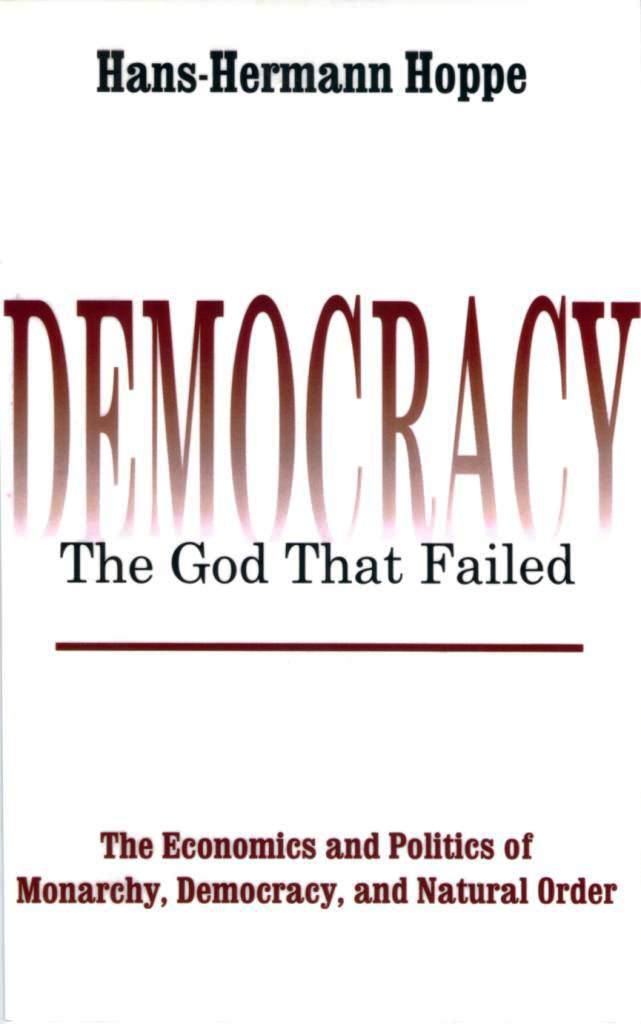
- Democracy: The God That Failed (Transaction, 2001)
- From Aristocracy to Monarchy to Democracy (Mises 2014)
- The Political Economy of Monarchy and Democracy, and the Idea of a Natural Order (Vol. 11 Num. 2) (excerpted as “Political Economy of Monarchy and Democracy,” Mises Daily (Feb. 1, 2010)
- Time Preference, Government, and the Process of De-Civilization – From Monarchy to Democracy, Journal des Economistes et des Etudes Humaines, Vol.5, 2, 1994; also published in John Denson, ed., The Costs of War (New Brunswick: Transaction Publishers, 1997) and as ch. 1 of Democracy: God that Failed
- The Trouble With Democracy, Nov. 12, 2001
- Prince Hans-Adam, The State in the Third Millennium (I.B. Tauris 2009)
- Kinsella, Hoppe Is Not A Monarchist
Romaric Godin, “Liechtenstein’s Feudal Prince Has Become a Libertarian Hero,” Jacobin (12.02.2025). Mentions Hoppe as well. Excerpt:
The prince of Liechtenstein’s actions have not gone unnoticed in libertarian circles. The German-born economist Hans-Hermann Hoppe, a disciple of Murray Rothbard, has made this country a model for his idea that monarchy is superior to democracy when it comes to “freedom.”
In 2022, Hoppe spoke about his dream of “a Europe of 1,000 Liechtensteins,” which closely resembles the vision expressed by Peter Thiel: “If we want to advance freedom, we need to increase the number of countries.” Argentina’s far-right president, Javier Milei, has described Hoppe and Rothbard as his main sources of inspiration.
Anarcho-Feudalism
What Hoppe finds most desirable about Liechtenstein is the fact that its state is entirely privately owned. As Hans-Adam points out in his book: “The costs of our monarchy, unlike all other monarchies, are covered by the private funds of the princely family.” The prince does not live off taxes; on the contrary, he supports the state, which is his patrimony. This is what makes this monarchy a form of “anarcho-capitalism.” Everywhere power is private and linked to property — in other words, to money.
In his 2001 book, Democracy: The God That Failed, Hoppe argued (against all historical evidence) that the transition from monarchy to democracy constituted a decline, because the monarchs took care of their private patrimonies and therefore tended to avoid imposing taxes and promote economic development. The ideal monarchy described by Hoppe resembles Hans-Adam’s Liechtenstein: the monarch does not need taxes to support himself because he runs his own business, whereas the leader of a democracy “lives” off taxes and therefore tends to increase them.
While the prince of Liechtenstein has never quoted a libertarian author in public, the similarities between his outlook and Hoppe’s thinking are striking. In 2020, another libertarian economist, Andrew Young, described Liechtenstein as the “the most tolerable form of state in existence today” in a journal article for the Mises Institute.
Hans-Adam has thus helped to design a new type of state, one that merges with the private sector around a monarchy of feudal origin. This example is reminiscent of the ideas of Curtis Yarvin, which are now inspiring Silicon Valley. Amid the current rise of capitalist authoritarianism, this little Alpine prince seems to be showing the way to the far right — a path in which democracy becomes a meaningless ritual.